Blog
Hole Punch Sizes: Matching the Punch to the Material

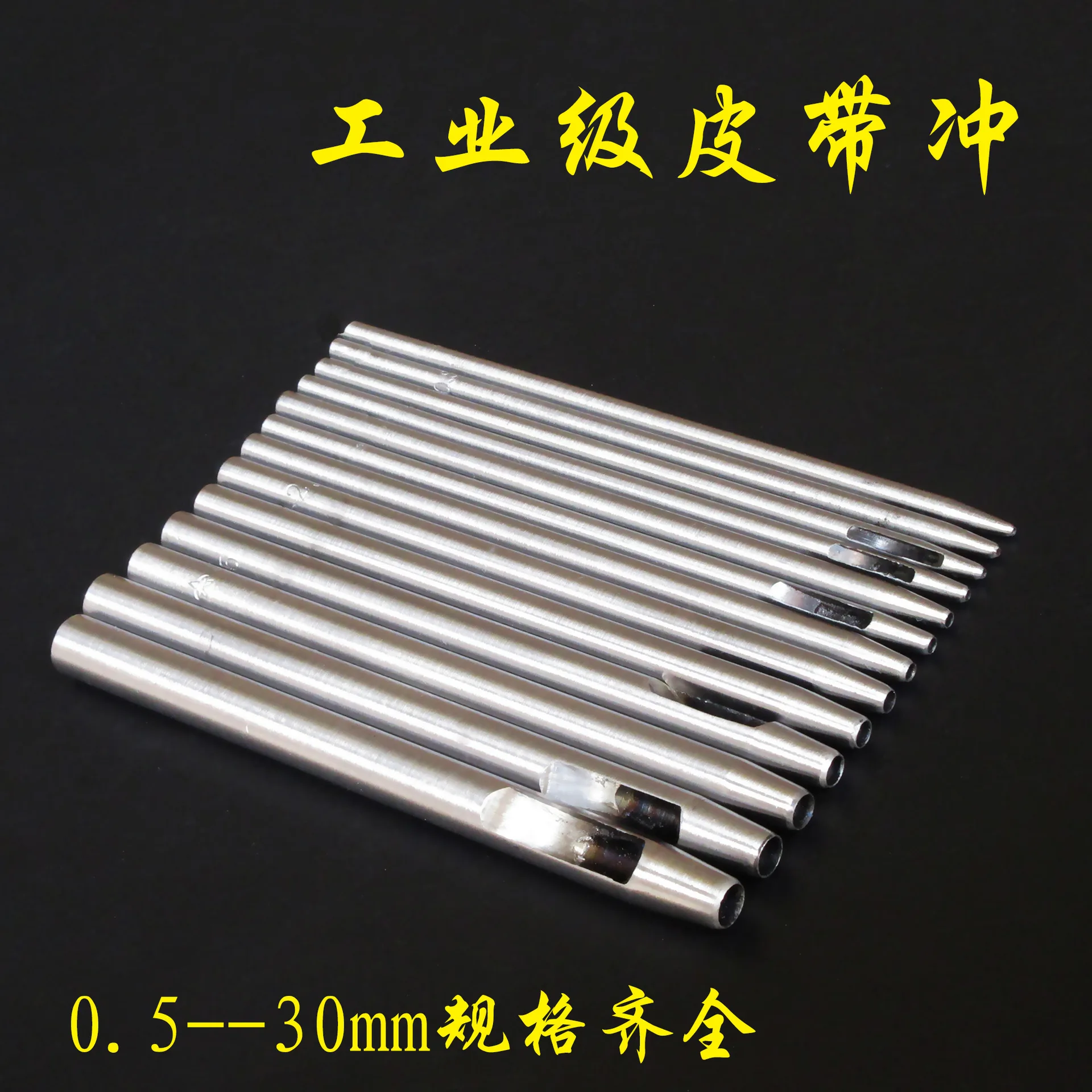
A hollow punch cuts a clean circle through leather, rubber, gasket sheet, felt or plastic by driving a thin-walled tube through the material. Unlike a drill, it removes a disc rather than making swarf, and unlike a knife it produces a round hole of a known size. The two decisions are the diameter and the wall quality, and the second is what decides whether the hole is clean or ragged.
How a hollow punch cuts
The cutting edge is the thin wall at the end of the tube. Pressure is applied, the wall shears the material against a backing surface, and the disc is pushed up inside the bore. The geometry of that wall is the whole tool: too thick and it crushes the material instead of cutting it, too thin and it folds over on the first hard job.
| Part | Function | Sign of a problem |
|---|---|---|
| Cutting edge | Shears the material | Ragged holes or a rolled edge |
| Bore | Stores the cut disc | Discs jam and block the punch |
| Body | Transmits the force | Dents or bends under a hammer |
| Top face | Struck or gripped | Mushrooms and splits |
The backing surface matters as much as the punch. Cutting onto a soft board lets the edge sink in and shear cleanly; cutting onto steel blunts the edge almost immediately. A hardwood block, a polymer cutting mat or a sheet of lead are the usual backings.
Sizes and what they are for
Hollow punches are sold as a single diameter or in sets, and the sizes cover two very different worlds: the small diameters used for fittings and fasteners, and the larger ones used for pipe and cable grommets.
| Band | Diameters | Typical use |
|---|---|---|
| Micro | Around 0.5 mm to 2 mm | Instrument gaskets, thin sheet, model work |
| Small | Around 3 mm to 6.5 mm | Fastener clearance, leatherwork |
| Mid | Around 9 mm to 16 mm | Hose and cable entries, gasket bolt holes |
| Large | Around 19 mm to 30 mm | Pipe grommets, large gaskets, sheet rubber |
The micro sizes are the ones most often needed and least often stocked, because they are used on gaskets and instruments where a neat small hole cannot be made any other way.
Material thickness and the right backing
A hollow punch will cut material far thicker than its own wall, provided the edge is sharp and the backing is right. What defeats it is a material that compresses rather than shears — soft foam, thick felt, some plastics — where the punch sinks in and pushes the material aside rather than cutting through it. In those cases the hole is cut from both sides, or the material is frozen or clamped between two boards first.
The general rule for clean work is one firm blow rather than several light ones. Repeated taps let the material recover between strikes, which produces a ragged edge. A single decisive strike with a mallet, on a suitable backing, gives the cleanest result and the longest edge life.
Hole punch sizes in this range
Every option in this range
Sixteen diameters from a 0.5 mm micro punch up to a 30 mm large punch. Prices are per punch.
| Diameter | Typical use | Price |
|---|---|---|
| 0.5 mm | The smallest gasket and instrument holes | $10.27 |
| 1.2 mm | Small instrument work | $10.27 |
| 1.8 mm | Fine gaskets and thin sheet | $8.99 |
| 3.0 mm | Fastener clearance holes | $10.27 |
| 4.0 mm | Small bolt clearance | $10.27 |
| 5.5 mm | Leatherwork and small gaskets | $14.77 |
| 6.5 mm | Cable and small hose entries | $19.91 |
| 9.0 mm | Mid-size gasket bolt holes | $26.97 |
| 11 mm | Hose entries | $26.97 |
| 14 mm | Larger hose and cable work | $26.97 |
| 16 mm | Grommet holes | $26.97 |
| 19 mm | Pipe and cable entries | $26.97 |
| 21 mm | Larger pipe grommets | $26.97 |
| 24 mm | Sheet rubber and large gaskets | $26.97 |
| 26 mm | Heavy gasket work | $26.97 |
| 30 mm | The largest diameter here | $26.97 |
Price rises sharply above the micro sizes and then flattens from about 9 mm upward, so the small diameters are cheap and the large ones cost about the same as each other.
Cutting clean holes
- Cut on a soft backing: hardwood, polymer mat or lead, never on steel.
- Keep the punch square to the material so the hole is round, not oval.
- Use one firm blow rather than several light taps.
- Clear the disc from the bore after every cut so the next one seats properly.
- Lubricate the wall lightly when cutting rubber or gasket sheet.
- Sharpen the cutting edge on a fine stone, working from the outside only.
Holes in gaskets and seals
Gasket work is where a hollow punch earns its place, because a gasket has to fit around bolts and ports exactly. The method is to lay the gasket sheet on a soft backing, mark the centres, and cut the bolt holes with the matching punch before cutting the larger port openings. Cutting the big openings first weakens the sheet and lets it distort while the small holes are being made.
Where a hole must be positioned precisely, the punch can be located over a pilot hole or guided by a drilled block. For a one-off gasket, a light tap to mark the position and then a full strike is usually accurate enough; for a repeated job, a guide block pays for itself in the first hour.
Keeping the edge sharp
The cutting edge is a thin wall, and it is the part that fails. It fails in two ways: it rolls over if the punch is struck against steel or used on material that is too hard, and it dulls gradually through ordinary use. A rolled edge can sometimes be dressed back; a dulled edge responds well to a few passes on a fine stone, working around the outside of the wall so the bevel is maintained rather than flattened.
Sharpening from the inside is a common mistake, because it removes the wall thickness that gives the punch its strength. Working only from the outside keeps the bore true and preserves the geometry that makes the tool cut rather than crush.
Frequently Asked Questions
What is a hollow punch used for?
Cutting clean circular holes in leather, rubber, gasket sheet, felt and plastic by driving a thin-walled tube through the material.
What should I cut onto?
A soft backing such as hardwood, a polymer cutting mat or lead. Cutting onto steel blunts the edge almost immediately.
Why is my hole ragged?
Usually because the edge has dulled, the backing is too hard, or the punch was tapped repeatedly instead of struck once firmly.
Can a hollow punch cut metal?
Not ordinary sheet metal. It is designed for softer materials; metal needs a different type of punch entirely.
How do I sharpen a hollow punch?
Work the outside bevel on a fine stone with light pressure, keeping the edge square. Never sharpen from the inside.
Choosing the right punch
Decide the material and the required diameter, then choose a punch with a thin, well-hardened wall. The hole punch range covers 0.5 mm to 30 mm, from instrument gaskets through to pipe and cable entries.