Blog
Industrial Sewing Shears: Tension Adjustment and Blade Length

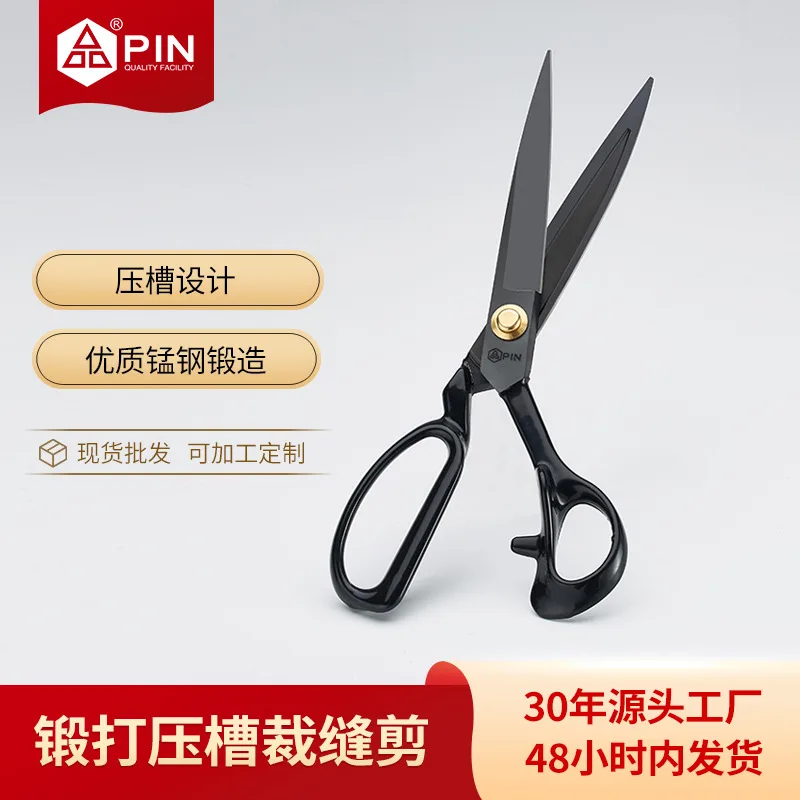
Sewing shears are the one pair of scissors in a house that has to stay sharp for years. Cutting fabric blunts an edge quickly, and the difference between shears built for the work and general scissors shows up within a season of regular use.
This range covers high-carbon industrial sewing shears with an adjustable tension screw, in sizes PIN-8 to PIN-12, from 14.99 to 21.99 dollars. This guide explains what the adjustment does, which size suits which work, and how to cut several layers cleanly.
What the adjustable screw changes
The screw at the pivot controls how tightly the blades are held together. Too loose and the blades push the fabric apart instead of cutting it; too tight and the shears are hard to close and the blades wear against each other.
| Setting | Behaviour | Suits |
|---|---|---|
| Loose | Blades separate; fabric folds between them | Nothing; this is a fault |
| Correct | Blades cut along their full length | Most fabric and light layers |
| Slightly tight | Clean cut with more effort | Dense or coated fabric |
| Very tight | Difficult to close; accelerated wear | Not recommended |
Adjustability is what makes a pair of shears last. As the blades wear the pivot loosens, and being able to take up that slack restores the cut. Without adjustment the shears begin to fold fabric instead of cutting it and are usually thrown away.
Blade length and what it is for
Longer blades cut more with each stroke and hold more layers, and they are heavier in the hand. Shorter blades give more control for curves and detail.
| Size | Blade length | Typical use |
|---|---|---|
| PIN-8 | Around 8 in | Light fabric, detail and curves |
| PIN-9 | Around 9 in | General dressmaking |
| PIN-10 | Around 10 in | Multi-layer cutting |
| PIN-11 | Around 11 in | Upholstery and heavier cloth |
| PIN-12 | Around 12 in | Long straight cuts, many layers |
The longest sizes are usually reserved for cutting out on a table, where several metres of straight cutting is done in one pass. Short blades are used at the machine for trimming, where control matters and a long blade would be awkward.
Adjustable sewing shears in this range
Every option in this range
High-carbon steel sewing shears with an adjustable tension screw, in five sizes. Prices are per pair.
| Option | Detail | Price |
|---|---|---|
| PIN-8 | High-carbon steel, adjustable pivot | $14.99 |
| PIN-9 | High-carbon steel, adjustable pivot | $15.99 |
| PIN-10 | High-carbon steel, adjustable pivot | $17.99 |
| PIN-11 | High-carbon steel, adjustable pivot | $18.99 |
| PIN-12 | High-carbon steel, adjustable pivot | $21.99 |
The price rises gradually with blade length because longer blades use more steel and need more careful grinding. For general dressmaking, the middle sizes represent the best balance of control and capacity.
Keeping shears cutting cleanly
- Cut fabric only; paper, card and wire blunt the edge faster than anything else.
- Adjust the pivot as the blades loosen, rather than pressing harder.
- Wipe the blades after cutting coated or synthetic fabric, which leaves residue.
- Store the shears closed and dry, in a sheath or a case.
- Oil the pivot occasionally, and never force the blades through a dense seam.
- Have the blades professionally sharpened rather than grinding them at home.
Cutting several layers without shifting them
Cutting out a garment usually means cutting through two or more layers, and the difficulty is that layers move against each other as the shears advance. The technique and the tool both matter here.
| Layers | Difficulty | What helps |
|---|---|---|
| One layer of light cotton | Minimal | Any sharp shears |
| Two layers | Layers can separate | Longer blades, steady stroke |
| Four or more layers | Shears lift the fabric | Long blades and a firm hold |
| Slippery synthetics | Layers slide apart | Pin or weight the fabric first |
| Dense or coated fabric | Blades bind | Take two passes, not one heavy cut |
Keeping the shears flat on the table and letting the lower blade run along the surface is what stops the layers riding up between the blades. Cutting on the table rather than in the air also removes the temptation to close the blades fully on every stroke, which is what pushes fabric forward.
Short strokes with the full length of the blade used progressively are more accurate than long, snapping cuts. This also puts less load on the pivot, which keeps the tension adjustment effective for longer between maintenance sessions.
What separates industrial shears from household scissors
The difference is in the steel, the pivot and the geometry of the blades. Household scissors are made to a price and are expected to cut paper, string and wrapping; industrial shears are made to be adjusted, sharpened and used for years on fabric.
| Feature | Household scissors | Industrial shears |
|---|---|---|
| Steel | Stainless, moderate hardness | High carbon, holds an edge |
| Pivot | Riveted, fixed | Screwed, adjustable |
| Blade geometry | Shorter, more angled | Longer, flatter cutting arc |
| Sharpening | Difficult to restore | Designed to be reground |
| Handle | Moulded, sometimes offset | Shaped for a full hand grip |
High-carbon steel is the reason industrial shears cut fabric cleanly. It takes a finer edge than a soft stainless and holds it longer, at the cost of needing to be kept dry. Fabric work is dry by nature, so the trade is a good one.
The screwed pivot is the other half of the story. It allows the blades to be brought back together as they wear and it allows the shears to be taken apart for cleaning and sharpening, which is what makes a long service life possible at all. A riveted pair cannot be maintained and is replaced when it dulls.
Frequently Asked Questions
How is the tension set correctly?
Tighten the screw until the blades cut along their full length with even resistance, and no further. The shears should close smoothly, not stiffly.
Which size is best for dressmaking?
Around 9 to 10 inches, which cuts multiple layers comfortably while staying light enough to control.
Can these shears cut leather?
They will cut thin leather and similar materials. Thick and hard leather needs dedicated shears or a rotary cutter.
Why do my shears fold fabric instead of cutting it?
Usually the pivot is loose or the edge is dull. Tighten the screw first, and if the cut is still poor the blades need sharpening.
How are they sharpened?
The bevel is ground at a specific angle, and shears are best sharpened by someone familiar with them. Home grinding rounds the ridge along the blade and ruins the cut.
Choosing the right shears
Match the blade length to the size of the pieces being cut and the number of layers. The sewing shears in this range cover five sizes with the same adjustable pivot.
Most households are well served by one mid-size pair for cutting out and a small pair for trimming at the machine. Buying the longest shears first tends to produce a heavy tool that is only used when there is a large amount of straight cutting.