Blog
Scissors Technique: Why They Chew and How to Cut Cleanly


Scissors cut by shear, not by pressure. Two blades pass each other with a controlled clearance, and whatever material is trapped between them is sliced along that line. That single fact explains nearly every problem people have with a pair: material folding instead of cutting, a cut that wanders, blades that chew rather than slice. This guide covers the technique that gets a clean cut from any pair, the materials that should never meet a scissors edge, and how to tell a technique problem from a tool problem.
Why scissors chew instead of cut
- Material folded between the blades. Scissors shear what is held flat. Anything that doubles over is cut in one place and torn in another.
- Blades riding over each other. The clearance between the blades is set by the pivot. Once it opens up, the material slips between them instead of being sheared.
- Cutting with the tips. The blades have the most leverage and the least clearance at the pivot end. Cutting at the tips is the hardest way to use a pair.
- A blunt or notched edge. A small notch leaves a strand uncut on every stroke, which feels like the scissors is blunt when most of the edge is fine.
- Material too heavy for the handles. Short handles cannot generate the force a thick material needs, so the cut stalls and the material tears.
- Cutting abrasive or hard material. Card, sandpaper and wire take the edge off a scissors faster than fabric ever will.
Material against technique
| Material | How to cut it | Watch for |
|---|---|---|
| Fabric and textile | Hold taut, take long strokes with the full blade | Allowing the cloth to fold between the blades |
| Bandage and dressing | Lift with a curved blade or hold clear with a straight one | Cutting into what lies underneath |
| Paper and card | Short strokes, accept that the edge will dull | Using the pair you cut fabric with |
| Plastic film and sheet | Keep tension on the film and cut along a line | Film wrapping itself around the blades |
| Thin sheet metal | Do not use scissors; use tin snips | Rolling the edge and spreading the blades |
| Wire and cable ties | Do not use scissors; use cutters | Notching the edge, which cannot be honed out |
The last two rows matter more than they look. A pair that has been used on wire has a notch in the edge, and a notch changes the way the blades meet for the rest of the tool’s life. Keeping one pair for textile and a second for anything rough is cheaper than replacing a good pair twice a year.
The scissors in this guide
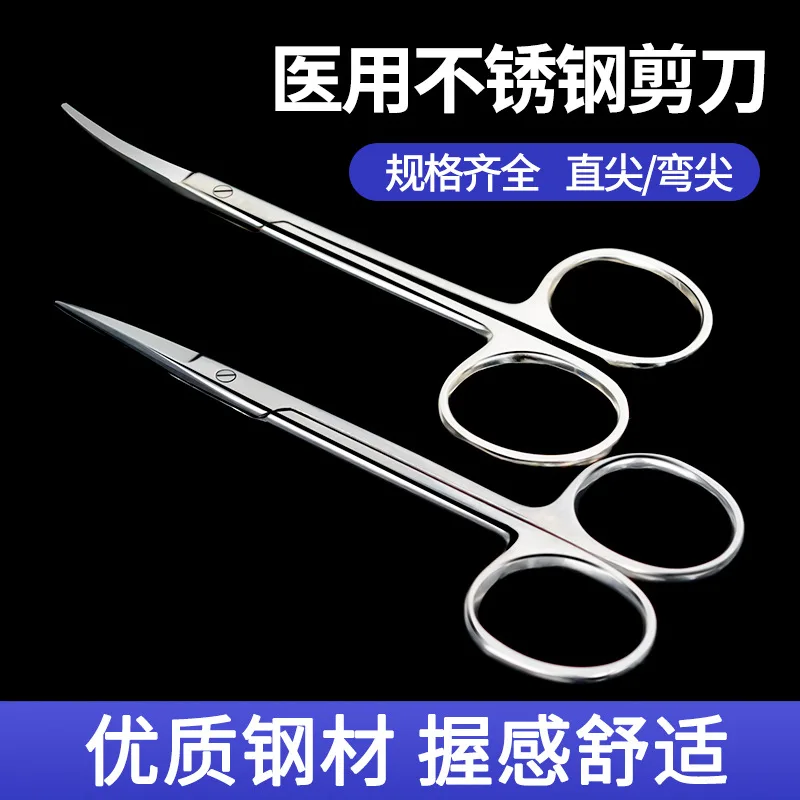
Every option in this range
Five lengths at five price points. Prices are per unit.
| Length | Supplied as | Best for | Price |
|---|---|---|---|
| 10 cm | Single pair | Thread, tape and fine trimming | $8.99 |
| 12.5 cm | Single pair | The pocket size for general cutting | $10.61 |
| 14 cm | Single pair | Dressings, fabric and bench work | $11.49 |
| 16 cm | Single pair | Longer cuts and heavier textile | $13.73 |
| 18 cm | Single pair | Kits and cutting where reach matters | $16.23 |
The price roughly doubles across the range for a blade that is less than twice as long, which is a fair reflection of what the larger pair does: it carries longer handles and heavier blades, and it cuts material the smaller pairs stall on. Buy the smallest pair that does not stall on your material rather than the largest you can afford.
Technique that gives a clean cut
- Hold the material taut. Cut with the material under slight tension, so the blades slice a flat surface rather than folding a loose one.
- Start the cut at the pivot end. Open the blades, engage the material as close to the pivot as the blades allow, and close them.
- Slide forward and close again. A scissors cut is a series of overlapping closures along the line, not one bite. Sliding forward as the blades close keeps the cut continuous.
- Keep the blades square to the material. Twisting the pair to steer the cut spreads the blades and produces a ragged line.
- Cut in one direction. Turning the material is easier than turning the scissors, and it keeps the blades meeting the same way for every stroke.
- Stop when the material starts to fold. Folding is the signal that either the blades have opened up or the material is too heavy for the pair. Forcing it tears the work.
Telling a tool fault from a technique fault
| What you see | Likely cause | What to do |
|---|---|---|
| Material folds instead of cutting | Blades have opened up at the pivot | Tighten the pivot; if a pair has no adjustment, it is worn out |
| One strand left uncut every stroke | A notch in the edge | Inspect the edge; a notch needs the bevel reset |
| Cut wanders off the line | Blades twisted to steer the cut | Keep the blades square and turn the material instead |
| Cut stalls part way through | Material too heavy for the handle length | Use a larger pair or a pair with longer handles |
| Edge dulls within a session | Cutting card, abrasive or wire | Keep a second pair for rough material |
Frequently Asked Questions
Why do my scissors tear fabric instead of cutting it?
Almost always because the cloth is not held taut or the blades have opened up. Hold the fabric under tension and check the pivot before blaming the edge.
Should I cut card with fabric scissors?
No. Card is abrasive and takes the edge off a pair quickly. Keep a separate pair for paper, card and anything rough.
How do I cut a straight line?
Mark the line, hold the material taut, keep the blades square and take overlapping strokes along the mark. Steering the scissors to follow the line is what makes a cut wander.
Can I cut wire with scissors?
No. Wire takes a notch out of the edge that cannot be honed away without resetting the bevel. Cutters are the right tool, and they cost far less than a good pair of scissors.
Is a longer pair always better?
Only up to the point where it stops stalling on your material. Beyond that the extra length costs control and accuracy without improving the cut.
Buying the right one
Buy the shortest pair that cuts your material cleanly, keep a second pair for paper and card, and use cutters rather than scissors on wire. The scissors in this range run from 10 cm to 18 cm.