Blog
Dressing Scissors Sizes: 10 cm to 22 cm, Straight or Curved

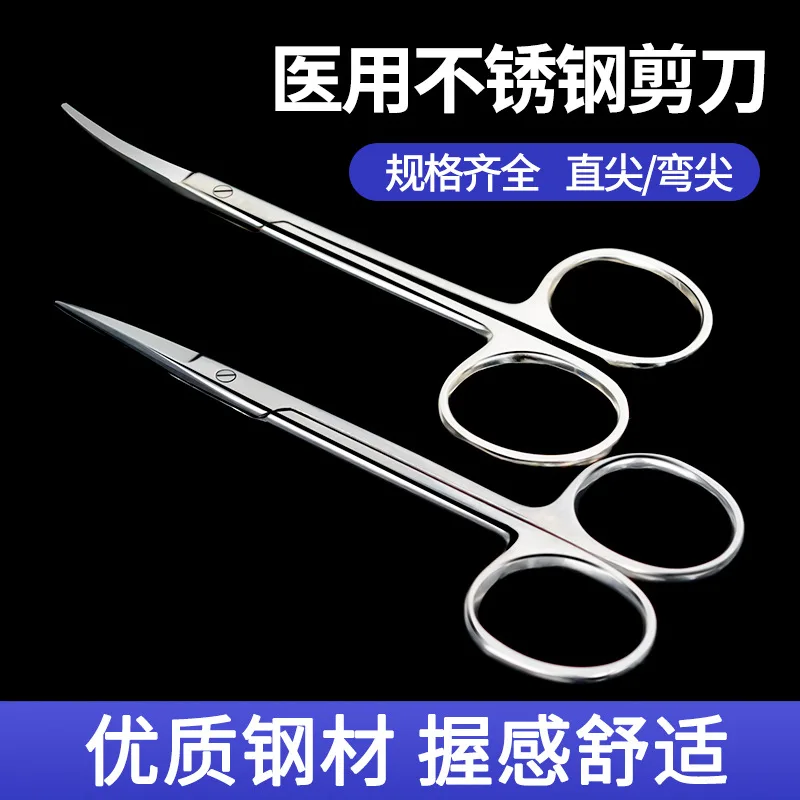
Dressing scissors are chosen by length and by blade shape, and the two together decide what the tool can reach and how it cuts. A short pair is the one carried in a pocket and used at the bench; a long pair reaches a dressing without leaning in. A straight blade cuts a line across material, and a curved blade rides along the surface so the material lifts away as it is cut. This range covers seven lengths in both shapes, and this guide explains which combination suits which job.
Length and shape: what each one decides
- Length sets reach and control. Short blades turn within a small area and give fine control; longer blades cover more material per cut and keep the hand further from the work.
- Straight blades cut clean lines. Used for trimming, cutting to size and cutting across a flat material where the edge has to be straight.
- Curved or angled blades lift as they cut. The lower blade rides along the surface under the material, so the cutter cannot press into what is underneath.
- Safety tips reduce the risk of a stab. Blunt or rounded tips are what make a pair usable near a person, a patient or a thin flexible surface.
- Handle length magnifies force. The same blade in a longer handle cuts heavier material with less effort, at the cost of control.
- Size affects the whole tool. A short pair fits a pocket and lives there; a long pair does not, and gets left in a drawer where it is not needed.
Length against the job
| Length | Straight blade | Curved blade |
|---|---|---|
| 10 cm | Trimming thread, tape and light bandage material | Small work where the blade has to ride a surface |
| 12.5 to 14 cm | The general pocket size; bandage and dressing work | Dressings that must be lifted as they are cut |
| 16 to 18 cm | Cutting to size, longer runs, bench and first-aid kits | Reaching across a dressing with the hand clear |
| 20 to 22 cm | Long cuts where the hand stays away from the work | Reaching into a dressing without leaning in |
The practical kit is two pairs: something around 12 to 14 cm that gets carried, and something around 18 cm for the bench or the kit. Buying only the largest size is the most common mistake, because a 22 cm pair is rarely the one within reach when a dressing needs cutting.
The scissors in this guide
Every option in this range
Seven lengths, each supplied in a straight pattern and a curved pattern where the range includes it. Prices are per unit.
| Length | Pattern | Best for | Price |
|---|---|---|---|
| 10 cm | Straight | Trimming thread, tape and light material | $8.99 |
| 12.5 cm | Straight and curved | The pocket size for dressing work | $11.24 |
| 14 cm | Straight and curved | Dressings and bandage material | $11.99 |
| 16 cm | Straight and curved | Cutting to size and bench work | $12.29 |
| 18 cm | Straight and curved | First-aid kits and longer runs | $13.78 |
| 20 cm | Straight and curved | Long cuts with the hand clear of the work | $16.93 |
| 22 cm | Straight and curved | Reaching across large dressings | $18.73 |
The curved pattern costs the same as the straight one at every length, so the shape is a free choice. That is worth taking advantage of: buy the straight blade for cutting lines and the curved blade for anything that has to be lifted as it is cut, at the same price.
Using them well
- Cut with the full length of the blades. Closing the blades around the material and sliding forward gives a clean shear. Chopping with the tips chews the material.
- Keep the material under tension. Scissors cut what is held taut. Material that is allowed to fold between the blades tears instead of slicing.
- Ride the surface with a curved blade. The curve is there to keep the lower blade flat against what is underneath while the material lifts away.
- Do not cut wire or card. Paper and card are abrasive, and wire takes a notch out of the edge. A notch cannot be honed out of a scissors bevel without resetting it.
- Cut away from the body and from fingers. The lower blade is the one that has to be watched, because it is the one moving along the surface.
- Wipe and dry after use. Even stainless blades mark if they are put away damp, and residues on the blade drag on the next cut.
One point that is easy to miss: handle length is not the same as blade length, and the two are not scaled together across the range. A pair with long blades and short handles feels slow and needs force to close, while a pair with short blades and long handles cuts quickly but loses accuracy. Judge a pair by the length of the cutting edge, then check that the handles are long enough for the material you will be cutting most often.
Frequently Asked Questions
What length scissors are best for a first-aid kit?
Around 14 to 18 cm. Long enough to cut a dressing without repositioning, short enough to fit the kit and be found when it is needed.
When should I choose a curved blade?
Whenever the material has to be lifted as it is cut, or when what is underneath must not be touched. For a straight edge on flat material, use the straight pattern.
Why do my scissors stop cutting cleanly?
Usually a loose pivot or a small notch in the edge. Tighten the pivot first; if the blades still ride over the material, the bevel needs work.
Can these cut fabric and leather?
Light fabric, yes. Leather and heavier textile are work for tailor shears with longer handles, which give the leverage those materials need.
Do the two shapes cost different amounts?
No. Straight and curved are the same price at each length in this range, so the shape is purely a question of what the work needs.
Buying the right one
Buy a carried size and a bench size rather than one compromise, and choose the curved pattern for any cutting that has to lift the material. The scissors in this range cover 10 cm to 22 cm in both shapes.