Blog
Mini Foot Pumps: What a 180 psi Compact Pump Can Do


A mini foot pump is the pump that actually gets used. It lives under a seat, in a pannier or in a drawer, and it is small enough that nobody resents carrying it. The trade is barrel volume: a small barrel reaches any pressure a car or bicycle needs, but it moves less air with each stroke.
This range is a compact steel-barrel pump rated to 180 psi, in three finishes. This guide explains what that rating means in practice and which jobs a small pump suits better than a large one.
What the 180 psi rating means
The rating is the maximum pressure the barrel, seal and hose are designed to contain. It is well above what any car tyre needs and comfortably above the working pressure of a road bicycle, which is why a small pump with a high rating is genuinely useful rather than a toy. What the rating does not tell you is how long the job will take.
| Figure | What it tells you | What it does not |
|---|---|---|
| 180 psi | The pump is built for high-pressure tyres | How many strokes a tyre will take |
| Barrel volume | How much air is moved per stroke | The pressure the pump can reach |
| Foot plate size | How stable the pump is underfoot | Whether the pump suits a large tyre |
| Hose length | How easily the pump reaches a valve | The quality of the connector seal |
The useful reading is that pressure and volume are separate specifications, and a mini pump is strong on the first and modest on the second. For a bicycle, that combination is ideal; for a van tyre, the same pump will do the job but will take a long time about it.
Where a compact pump wins
A pump is only useful if it is there when it is needed, and that is the argument for a small one. A compact pump fits in a pannier, a glovebox, a rucksack or a drawer, so it travels to the roadside rather than waiting at home.
| Situation | Mini pump | Full-size foot pump |
|---|---|---|
| Bicycle tyre on the roadside | Ideal; carried easily | Left at home |
| Car tyre top-up | Good; a few minutes of strokes | Quicker but bulky |
| Motorcycle tyre | Good | Good |
| Van tyre from flat | Slow but workable | The better choice |
| Sports equipment and inflatables | Good, with the right adapter | Better on large volume |
| Storage space in a small car | Fits almost anywhere | Needs planning |
The pattern is that the compact pump covers pressure work everywhere and volume work nowhere in a hurry. Anyone who looks after a bicycle, a motorcycle or a car with tyres that rarely go flat will find a mini pump does everything required, while anyone regularly filling large tyres from flat is better served by a bigger barrel.
Mini foot pumps in this range
Every option in this range
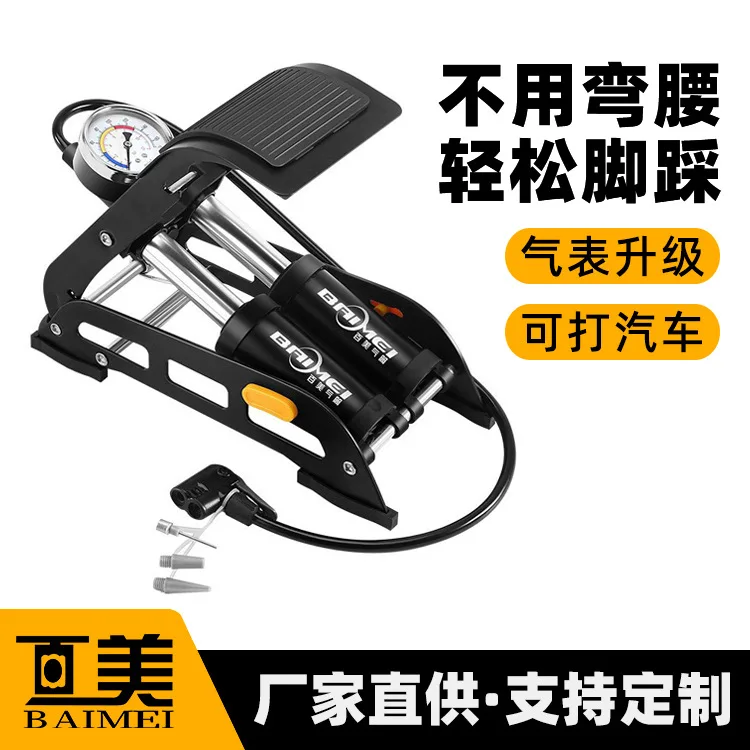
A compact steel-barrel foot pump rated to 180 psi, on a folding steel foot plate, in three finishes. Prices are per pump.
| Finish | Model | Price |
|---|---|---|
| Black | FP55S, steel barrel | $10.02 |
| Yellow | FP55S, steel barrel | $10.02 |
| Sky blue | FP55S, steel barrel | $10.02 |
All three finishes cost the same, so the decision is about visibility and tidiness. A bright finish is easier to find in a bag or a dark boot, which matters more than it sounds for a pump that is meant to be carried everywhere.
Getting the most from a small barrel
- Press with the whole foot in a steady rhythm rather than stamping, which is easier on the seal and the plate.
- Check the connector is fully seated before starting, because a small barrel wastes proportionally more air on a leak.
- Inflate in stages on a large tyre, checking the gauge between short runs rather than pressing continuously.
- Use the right valve adapter; a Presta bicycle needs a reducer, a football needs a needle.
- Do not lean on the hose to hold the pump steady, as the joint is the weakest point of a compact design.
- Store the pump with the plate released and the hose loosely coiled.
Stability and the small foot plate
A compact pump has a smaller foot plate, and that changes how it is used. On a hard, level surface it is perfectly stable, but on gravel, grass or a slope the plate rocks and the stroke becomes uneven, which is hard on the seal. Placing the pump on something flat, or standing it on a folded jacket at the roadside, is a small habit that makes a compact pump much easier to live with.
Holding the hose with one hand while pumping is also worth avoiding on a small pump. The hose joint on a compact design carries the same pressure as a full-size one but has less material around it, so pulling on the hose to steady the pump is the quickest way to start a leak. Standing the pump squarely and letting the foot plate take the load keeps the hose out of the argument.
Why the small pump is the one that gets used
Workshops and garages own large pumps, and the tyre that is low on a Sunday evening is still low on Monday morning because the big pump is at the back of a shed behind a bicycle. The pump that gets used is the one that is already in the car, and that is the strongest practical argument for a compact design with a high pressure rating.
It is also the reason a mini pump deserves the small extras that keep it working: an adapter or two kept with it, a replacement connector seal, and a bag to hold the whole lot. The total cost is trivial compared with the inconvenience of a flat tyre and no means of inflating it, and the kit takes up less room than a pair of gloves.
Frequently Asked Questions
Can a mini foot pump inflate a car tyre?
Yes, to normal car pressures. It takes more strokes than a full-size pump, so it is better suited to topping up than to filling from flat.
Is 180 psi enough for a road bicycle?
More than enough. Road tyres run at 80 to 120 psi, so the pump has capacity in reserve.
Why does a small pump take so many strokes?
Because the barrel is small, so each stroke moves less air. The pressure is not the limitation; the volume is.
Are mini foot pumps reliable?
Yes, provided the hose joint and connector seal are looked after. Those are the parts that fail first on any compact pump.
Should I keep the pump in the car all year?
Yes, in a bag rather than loose. It is then available when a tyre is low and protected from knocks the rest of the time.
Choosing the right one
Choose a compact pump when the pump has to travel with you, and a larger barrel when it does not. The mini foot pump range is rated to 180 psi and supplied in three finishes.