Blog
Handheld Electric Hole Punches for Channel and Angle Steel

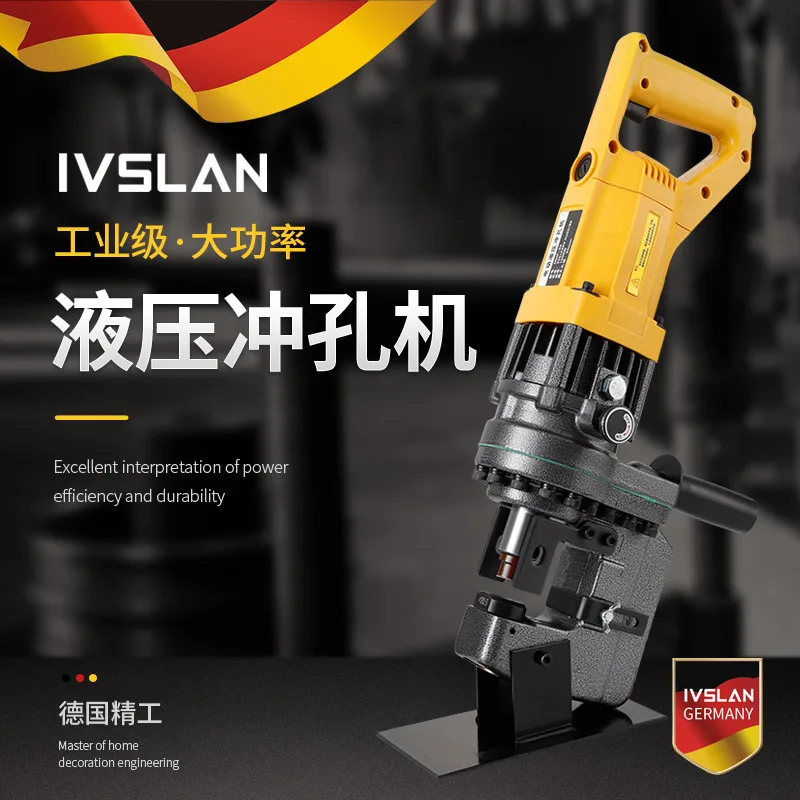
Punching a hole is faster than drilling one and leaves a cleaner edge. On channel and angle steel the difference is significant, because a drill wanders on a curved or angled surface while a punch simply shears through at the point marked.
This range covers handheld electric hydraulic punching machines in two versions, one for channel steel at 1107.69 dollars and one for angle steel at 981.82 dollars. This guide explains how they work, what the two versions are for and what decides the steel thickness they handle.
How an electric hydraulic punch works
A punch and a die are clamped either side of the workpiece. An electric pump drives a hydraulic ram that pushes the punch through the steel and into the die, and the ram then retracts. The hole is sheared rather than cut, which is why the edge is clean and the operation is quick.
| Stage | What happens | Why it matters |
|---|---|---|
| Mark and position | Hole centre marked on the steel | Sets accuracy |
| Clamp the punch | Punch and die either side of the section | Keeps the tool square to the face |
| Cycle | Ram drives the punch through | The work is done in seconds |
| Retract | Ram returns, tool released | Ready for the next hole |
| Deburr | Edge dressed if needed | Finishing for a bolted joint |
Because the tool shears, the quality of the hole depends on the punch and die being matched to the section. A punch used on steel thicker than it is designed for will distort the section instead of cutting it, and that is the failure mode to avoid.
Channel steel and angle steel versions
The two versions differ in how the tool clamps the section, because a channel and an angle present different faces and different clearances to the punch. Buying the version that matches the work avoids makeshift clamping that puts the hole in the wrong place.
| Version | Section it clamps | Typical use |
|---|---|---|
| Channel steel machine | U and C sections | Frames, purlins, strut and racking |
| Angle steel machine | L and equal angle sections | Brackets, bracing, handrails |
The channel version costs slightly more, reflecting the extra clearance the tool needs to reach across the flanges. Where both sections are used regularly, the correct machine for each pays for itself in time; where one dominates, buy for that one.
Handheld electric hole punches in this range
Every option in this range
Handheld electric hydraulic punching machines with an all-copper motor, in channel steel and angle steel versions. Prices are per machine.
| Option | Detail | Price |
|---|---|---|
| Angle steel machine | All-copper motor, hydraulic punch | $981.82 |
| Channel steel machine | All-copper motor, hydraulic punch | $1,107.69 |
Both are professional tools priced for repeat work. The deciding factor is the section being punched most often rather than the cost, since a machine that does not clamp the section in front of it correctly produces holes that have to be redrilled.
Punching steel without damaging the tool
- Match the punch and die to the section, and never force a pair through steel it was not made for.
- Keep the punch and die aligned; a misaligned pair chips its cutting edge quickly.
- Clear swarf from the die after every few holes; trapped slugs crack the cutting edge.
- Support the section so the tool is not carrying the weight of the steel as well as punching it.
- Check hydraulic fluid levels and hoses as part of routine maintenance.
- Deburr the hole before bolting so the joint seats properly.
Punching on site rather than in a workshop
Structural steel is usually drilled or punched before it is erected, but real jobs rarely go to plan. A hole is discovered to be missing, a bracket needs an extra fixing, or a handrail has to be added to an existing frame, and the work has to be done where the steel already stands.
| Site situation | What the punch offers | What to watch |
|---|---|---|
| Extra hole in a fixed column | No drill access or power lead needed | Tool weight held overhead |
| Racking and strut | Fast repeat holes in thin section | Section must be supported |
| Handrail brackets | Clean hole that takes a bolt immediately | Alignment of the bracket after punching |
| Repair work on galvanised steel | Less damage to the coating than drilling | Touch up the cut edge afterwards |
Galvanised and coated sections are the case where punching shows a clear advantage. A drill removes the coating in a swirl around the hole, while a punch shears through and leaves a much smaller area to touch up, which matters where corrosion resistance is the reason for the coating.
The limitation is access for the tool itself. A punch needs clearance on both faces of the section for the punch and the die, and where a section is boxed in or sits against a wall, the tool cannot be positioned. Checking that clearance before buying is as important as checking the steel thickness.
One more practical point: keep a spare punch and die on site. A chipped cutting edge stops the machine working, and a set of replacements costs a fraction of a day lost waiting for one to be ordered and delivered.
Regular use also rewards a quick check of the hydraulic hose and couplings, since a weeping coupling loses force gradually and the first sign is usually a punch that no longer completes a cycle in thick section.
Frequently Asked Questions
How thick can a handheld punch go?
It depends on the punch and die fitted and the machine’s force. Thicker sections need a bigger machine rather than more pressure on a small one.
Is a punch better than a drill for steel?
For repetitive holes in structural sections, yes: it is faster, leaves a cleaner hole, and does not wander on an angled face.
Can the same machine punch both channel and angle?
The two versions are set up for different sections. Some work can be done on either, but the clamping geometry is designed around one of them.
What does an all-copper motor mean?
The motor windings are copper rather than aluminium, which handles load and heat better and is generally longer lived.
How are holes positioned accurately?
Mark the centre, position the punch and check the alignment of the punch against the mark before starting the cycle.
Matching the machine to the section
Look at the steel being punched most often and buy the machine built for that section. The handheld electric hole punch range here covers both versions.
For a fabricator working mostly in angle, the angle machine is the sensible first purchase, with the channel version added when that work justifies it. Buying the wrong one leads to makeshift setups that cost more time than the second machine would have cost.