Blog
Ratchet Screwdrivers: How the Mechanism Helps and Limits

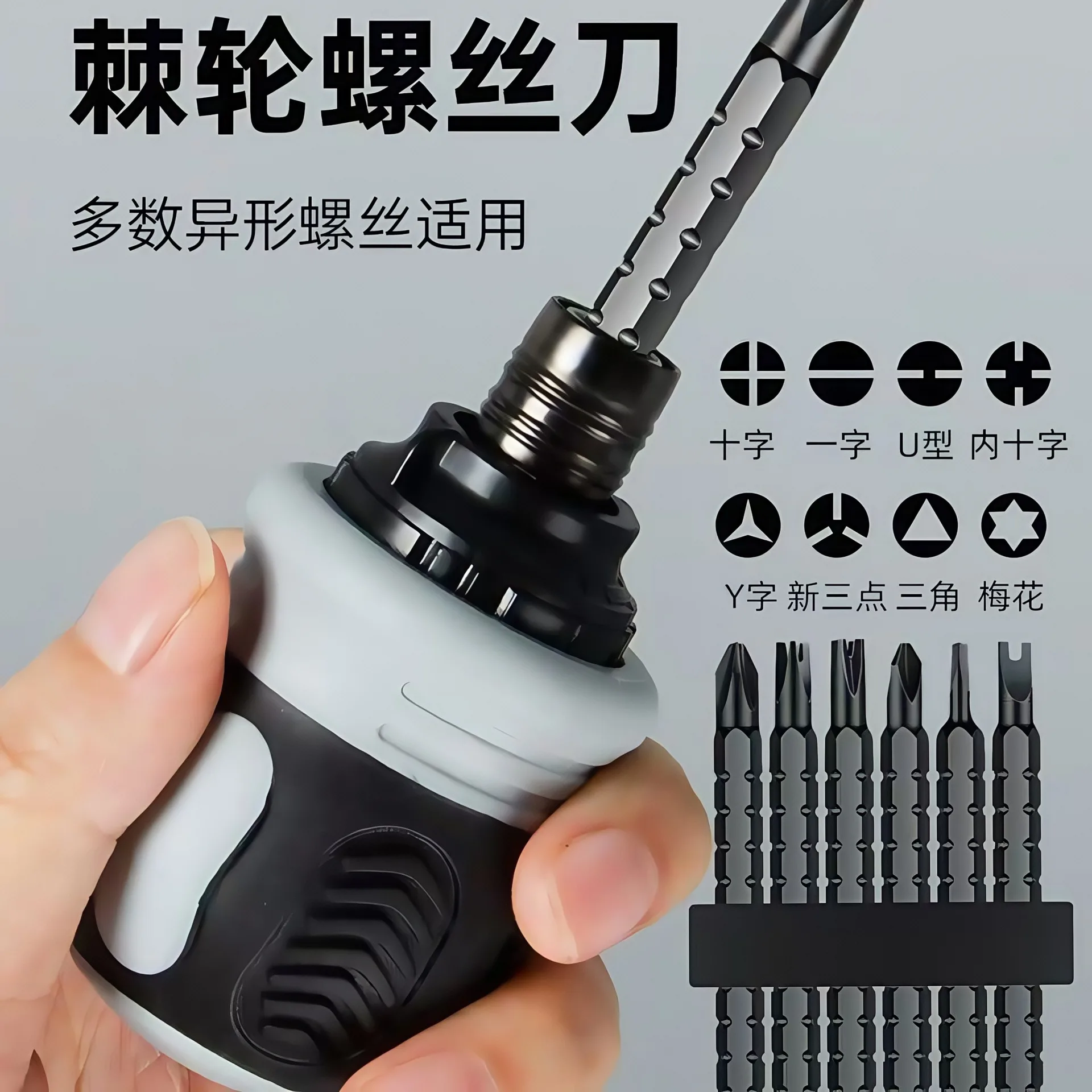
A ratchet screwdriver does one thing that a plain driver cannot: it lets the handle be turned back and forth without the tip leaving the screw. That sounds like a small convenience, and on a single screw it is. On forty screws in a row it changes the job, because the hand never has to release, reposition and re-seat the tip, which is where most screw heads get damaged.
How the ratchet mechanism works
Inside the handle sits a pawl that engages a toothed ring, so the shaft turns with the handle in one direction and slips in the other. The simplest tools offer a single direction, which is enough for driving screws in; better ones add a locking position, where the driver behaves like a fixed screwdriver, and a reverse position for undoing screws.
| Position | What it does | When it is used |
|---|---|---|
| Drive | Turns the screw clockwise, slips anticlockwise | Most of the tightening work |
| Reverse | Turns the screw anticlockwise, slips clockwise | Removing screws |
| Locked | Fixed drive in both directions | Final tightening and loosening tight screws |
The locked position is the one that matters most in practice. A ratchet gives convenience but not much torque, so the final nip on a screw should always be applied with the mechanism locked, which turns the tool into an ordinary driver for that last movement.
Where a ratchet earns its place
The advantage grows with the number of screws and shrinks with the space available. Long runs of similar fastenings benefit enormously, especially where the driver has to be held at an awkward angle and the hand cannot easily be repositioned. Panel work, appliance casings and flat-pack assembly are the classic cases.
| Job | Ratchet driver | Plain driver |
|---|---|---|
| Long runs of similar screws | Much faster | Slower and more tiring |
| Awkward angles | Hand can stay in position | Hand must release and reposition |
| Final tightening to torque | Needs the locked position | Direct and predictable |
| Seized or very tight screws | Limited by the mechanism | Better, especially with a bolster |
Where the work is one or two tight screws, a plain driver is the better tool. The ratchet mechanism adds a joint between hand and tip, and that joint absorbs some of the force, which is exactly what a seized fastening does not need.
Bits, holders and what fits
Ratchet drivers usually take interchangeable bits in a standard hex size, which is what makes them versatile: one handle covers flat, Phillips, Pozidriv, star and hex fastenings. The bit size also sets the scale of the work, since a small hex holder suits precision bits and a larger one takes standard 1/4 in bits and socket adaptors.
Bit storage in the handle is a small feature with a real effect. Drivers that hold a set of bits inside the grip mean the right bit is always with the tool, and the handle is thicker as a result. Where the driver will be used on one type of fastening, a plain handle and a separate bit holder is lighter and cheaper.
Handle shape and the one-hand question
Because the hand does not have to leave the handle, a ratchet driver is often worked one-handed, with the other hand holding the part or the panel. That makes handle shape more important than it is on a plain driver: a broad body that fills the palm allows the wrist to drive the ratchet without the fingers gripping hard, while a slim cylindrical handle forces a tighter grip and tires the forearm faster over a long run of screws.
A swivel or ball-ended top helps as well, since it lets the palm press down while the fingers turn, keeping the bit seated in the recess through both the drive and the return stroke. Where the fastening is shallow, that constant seating is what stops the bit climbing out and marking the head.
The ratchet screwdrivers in this range
Every option in this range
Two options covering a compact micro driver and a larger pattern. Prices are per driver.
| Option | Type | Format | Best for | Price |
|---|---|---|---|---|
| Compact ratchet driver | Small bit holder | Single driver | Small fastenings and precision work | $8.99 |
| Standard ratchet driver | Multi-piece bit set | Driver with bits | General assembly and long runs of screws | $12.75 |
The compact version is the one to keep in a small kit, while the multi-piece pattern is the better choice where the driver will be the main tool for assembly work across several fastening types.
Using a ratchet driver well
- Lock the mechanism for the final tightening so the screw is properly nipped up.
- Match the bit to the screw recess; a ratchet turns a wrong bit just as hard as a right one.
- Keep the bit seated while ratcheting, since the mechanism does not hold the driver into the screw.
- Do not use a ratchet driver for high-torque work such as undoing rusted bolts.
- Keep the mechanism free of grit, which is what makes it slip or jam.
- Store the bits with the driver so a size is never missing mid-job.
Finally, consider how the driver will be carried. A ratchet driver with bits stored in the handle is self-contained, which is why it often replaces a small screwdriver roll in a mobile kit, but it is also bulkier and heavier than the plain driver it replaces. Where the tool lives on a bench, the extra bulk costs nothing; where it is carried all day, it is worth weighing against a lighter alternative.
Frequently Asked Questions
Is a ratchet screwdriver as strong as a normal one?
No. The mechanism adds a joint that absorbs some force, so a plain driver transmits more torque. Use the ratchet for driving and a plain driver for the tightest fastenings.
What is the locked position for?
It disengages the ratchet so the tool behaves like a fixed screwdriver. That is how the final tightening or the first loosening turn is made.
Which bit system do they use?
Most take standard hex bits, with the smaller patterns taking micro bits. The holder size is what decides whether 1/4 in bits and socket adaptors will fit.
Can a ratchet screwdriver be used for electrical work?
Only if the tool is rated and marked for it. A ratchet mechanism and bit holder are not insulation, and live work needs rated tools and safe practice.
Why does my ratchet slip?
Usually grit or wear in the pawl, or the mechanism sitting between positions. Clean it, work it through the positions, and replace the driver if the pawl has worn.
Choosing a ratchet driver
Decide the bit system from the fastenings you meet, then whether you want a compact driver or one that carries a full set of bits. The ratchet screwdriver range covers both ends of that choice, from a compact driver for small work to a multi-piece pattern for assembly jobs.