Blog
Tool Box Latches and Hinges: What Fails First

Tool boxes rarely fail at the shell. They fail at the latch and the hinge, because those are the parts that move thousands of times and take the load every time the box is picked up. A box with a cracked catch is still a box, but it is one that opens in a van and spills tools across a floor.
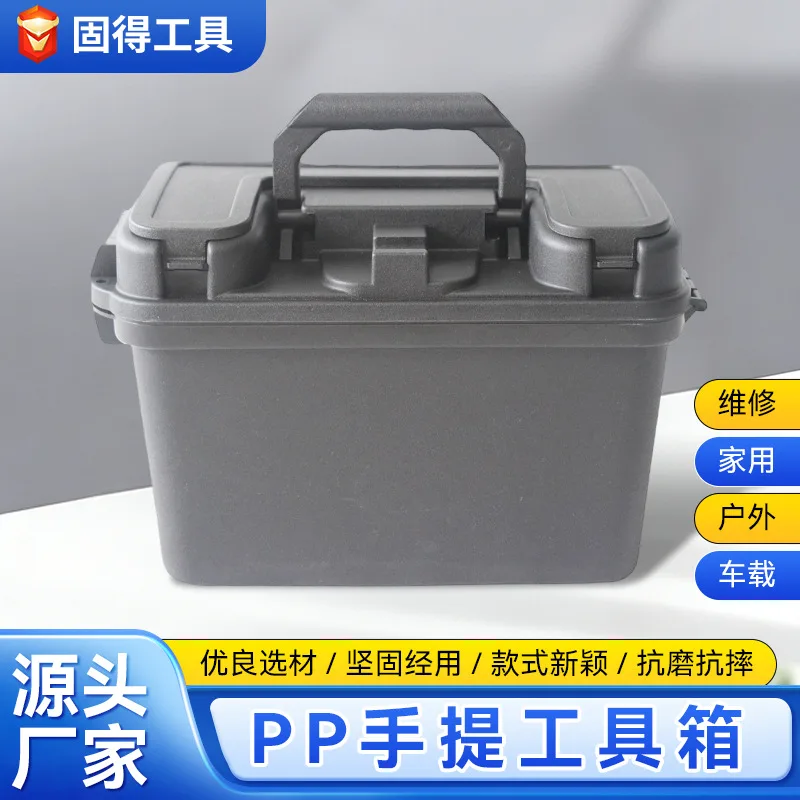
This range covers a moulded tool box at $13.12. This guide is about the two moving parts, how to judge them before buying and how to make them last.
Latch designs compared
A latch has to do one thing well: hold the lid closed while the box is carried by its handle, which means taking the whole weight of the contents through the catch. Designs differ in how they achieve that, and the difference shows up after a year of use rather than on the first day.
| Latch type | How it holds | Strength | Failure mode |
|---|---|---|---|
| Friction or snap catch | A moulded lip snaps over a ridge | Adequate for light loads | The lip wears and stops gripping |
| Positive catch with a lip | A shaped tongue hooks under a ledge | Good; resists being pulled open | The tongue cracks at its root |
| Over-centre catch | A lever passes through the centre and locks | The strongest of the three | The pivot pin or its moulding breaks |
| Draw latch with a spring | A sprung hook pulls the lid down | Good, and tolerant of wear | The spring fatigues and the pull weakens |
For a box carried by its handle with any weight inside, a friction catch is the weakest choice because the whole load hangs on a moulded lip. An over-centre catch is the strongest and the one most likely to survive being dropped, though it is also the one that fails suddenly when its pivot gives way.
Hinges: the joint that decides alignment
The hinge matters because it decides whether the lid still meets the box squarely after a year. A piano hinge running the full length of the lid spreads the load and keeps alignment; two separate hinges concentrate the load at their mountings, and a moulded hinge takes the stress into the plastic itself.
| Hinge | Alignment | Notes |
|---|---|---|
| Full-length or piano hinge | Excellent; the load is spread along the lid | The best design for a box carried with weight inside |
| Two moulded hinges | Good while new; drifts as the plastic wears | Common on moulded boxes; check for cracking at the roots |
| Metal pin through moulded lugs | Depends on the fit; the pin can work out | Watch for a pin that has moved or a cracked lug |
| Separate lid | No hinge at all; the lid lifts off | No wear point, but the lid can be lost |
A hinge that has begun to fail shows itself as a lid that needs to be pushed to close. Once the alignment is gone, the latch has to pull the lid into position on every closure, which accelerates wear at the catch. Sorting the hinge early is therefore what protects the latch.
Tool boxes in this range
Every option in this range
A moulded tool box with a hinged lid and a catch, in the entry and mid sizes. The price is per box.
| Item | Detail | Price |
|---|---|---|
| Tool box, mid size | Moulded body, hinged lid, catch | $13.12 |
| Small tool box | Compact body for a small kit | $8.99 |
| Large tool box | Full size with a lift-out tray | $17.34 |
The step up to the larger box costs a few dollars and is worth taking if the box will be carried with weight inside, since a larger box with a stronger catch copes better than a small one overloaded. Where the box stays on a shelf rather than travelling, the smaller size and lighter catch are perfectly adequate.
Making a catch last
- Never lift a box by the lid or by the tray; the catch is not designed for the load.
- Close the latch before picking the box up, every time, without exception.
- Keep grit out of the catch, since a single grain of sand will hold it open a fraction.
- Avoid over-filling the box, which forces the lid up against the catch under pressure.
- Check the hinge and the catch for hairline cracks at their roots once or twice a year.
- Store the box closed but not latched hard, so the catch is not under load when idle.
What to check in a shop
A latch can be judged in a few seconds. Close it and try to pull the lid up by the handle without lifting the box: a catch that holds under that test is well designed, and one that flexes open is not. Look too at the root of the catch, where it meets the body, because that is where a crack starts and it is usually visible before it becomes a failure.
The hinge deserves the same attention. Opening and closing the lid should feel smooth rather than gritty, and the lid should sit flat when closed without being pushed. A lid that springs up slightly at the front is a lid whose hinge or catch is already out of alignment, and that is the box that will open in a vehicle.
Handles, feet and the parts that take the strain
The handle and the base of a tool box take the load every time the box is moved, and they are the parts that show the design intent. A handle that is moulded into the lid is convenient and puts the whole weight on the catch; a handle moulded into the body carries the load through the shell and leaves the latch to do only its own job. On a box that will be carried with tools inside, the second arrangement is the one to look for.
Feet matter for a different reason. Small moulded feet keep the base off a wet floor and stop the box sitting in a puddle, and a box without them will draw water up into the base if it is left in a damp workshop. Even two or three millimetres of clearance is worth having, and the base ribs on a moulded box usually provide it.
Frequently Asked Questions
Why does my tool box lid keep popping open?
Usually a worn friction catch or a hinge that has drifted out of alignment. Check the hinge first, since a misaligned lid loads the catch.
What is the strongest latch design?
An over-centre catch, provided its pivot is sound. A positive catch with a lip is the next best and is less likely to break suddenly.
Can a broken catch be repaired?
Sometimes, with a strap or a bolt-on replacement catch, but on a moulded box the repair is usually weaker than the original.
Should I latch the box when it is empty?
Closing it is enough. Latching it hard when idle keeps the catch under load for no reason.
How do I stop the box opening in a van?
Latch it every time, and consider a strap around the box. A catch that is marginal at home will open under load in a moving vehicle.
Choosing a box with a sound latch
Test the catch with the weight of the box hanging from its handle. The moulded tool box in this range has a hinged lid and a positive catch.