Blog
Plastering Scrapers: Wide Blades from 25 to 120 cm Explained


A wide scraper does in one pass what a trowel does in four. That is the whole argument for the tool: on large flat surfaces a broad blade pulls filler, skim or adhesive across the wall in a single movement, and the surface ends up flatter because there are fewer overlaps to blend.
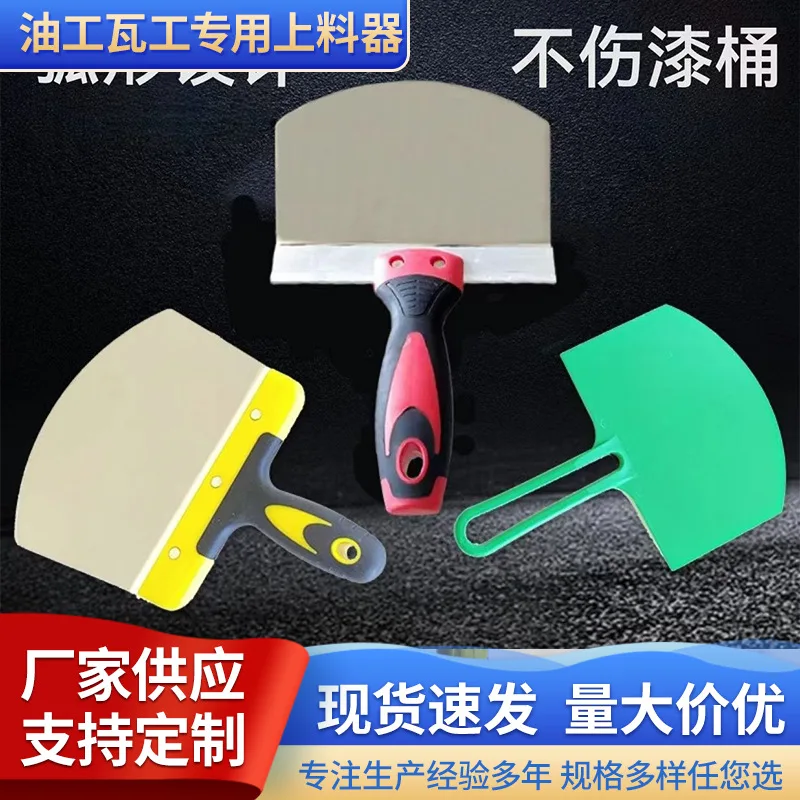
This range covers stainless steel scraper boards from 25 cm to 120 cm with a wide grip, from 8.99 to 26.97 dollars. This guide explains which width suits which surface, how the wide grip is used, and what to look after so the blade stays straight.
What the width decides
The width of the blade sets the size of the surface the tool is good for. A narrow board reaches into corners and follows an uneven wall; a wide one covers ground but bridges hollows rather than filling them.
| Width | Best used on | Note |
|---|---|---|
| 25 cm | Corners, reveals, patch repairs | Easiest to control |
| 40 cm | Small rooms and kitchens | A useful second size |
| 60 cm | Walls and larger ceilings | The common working width |
| 80 cm | Wide walls and ceilings | Needs a firm, flat surface |
| 100 to 120 cm | Large panels and long runs | Two-handed control |
As the blade widens, the technique changes. A 25 cm board is used like a trowel, one handed, with the wrist controlling the angle. A 120 cm board is a two-handed tool guided by the whole body, and it only works well on a surface that is already reasonably flat.
How a wide grip is used
The grip on a scraper board is designed to be held across the body rather than like a trowel handle, which spreads the effort and lets the blade be kept at a consistent angle through a long stroke. That consistency is what produces a flat finish.
| Technique | Effect on the finish | When to use it |
|---|---|---|
| Short overlapping strokes | Blends well, slower | Narrow boards and repairs |
| Full-width strokes | Fast and flat | Large boards on flat surfaces |
| Angled pull | Fills hollows | Rough or uneven walls |
| Flat pull | Levels the surface | Final passes |
The most common mistake is pulling too much material in one go. A wide board loaded with a thick bed of filler will ride over the surface rather than cutting it, and the result is a hollow that has to be filled again. Thin passes, repeated, produce a flatter wall than one heavy pass.
Plastering scrapers in this range
Every option in this range
Stainless steel scraper boards with a wide grip, in six widths. Prices are per board.
| Width | Detail | Price |
|---|---|---|
| 25 cm | Stainless blade, wide grip | $8.99 |
| 40 cm | Stainless blade, wide grip | $14.23 |
| 60 cm | Stainless blade, wide grip | $20.98 |
| 80 cm | Stainless blade, wide grip | $25.47 |
| 100 cm | Stainless blade, wide grip | $26.97 |
| 120 cm | Stainless blade, wide grip | $26.97 |
The price rises steeply to 80 cm and then flattens, so the widest boards cost little more than the mid sizes. The decision should be made on the surface rather than the price: a board wider than the wall can be controlled on is harder work, not faster work.
Keeping a scraper board straight
- Clean the blade while the filler or skim is still soft, using water and a scraper.
- Dry the blade after washing so the edge does not corrode along its length.
- Hang the board rather than standing it on a corner, which is how blades get bent.
- Do not lever with the blade or use it to lift materials off the floor.
- Check the edge against a straightedge occasionally; a dished blade leaves ridges.
- Store long boards flat if they have to be transported, supported at both ends.
Where wide scrapers are used outside plastering
The same tool turns up on jobs that have nothing to do with plaster. Anywhere a broad, flat blade has to move a soft material evenly across a surface, a scraper board does the job faster than a trowel, and in several trades it is bought for that reason rather than for skimming.
| Job | Why the wide blade helps | Width that suits |
|---|---|---|
| Levelling floor compound | Spreads the mix in one pass | 60 cm and above |
| Pulling wallpaper residue | Covers a strip of wall at a time | 25 to 40 cm |
| Clearing adhesive from a floor | Reaches under the covering | 40 to 60 cm |
| Spreading adhesive before tiling | Keeps the bed even across a panel | 25 to 40 cm |
| Filling large panel seams | Bridges the joint evenly | 60 cm and above |
Floor levelling compound is the clearest example. It has to be spread quickly before it starts to set, and a wide blade does it with far fewer passes than a trowel, which is why flooring contractors keep a board with the rest of the kit even when no plastering is involved.
Removing wallpaper residue and old adhesive is the other common use. The blade is used almost flat against the wall, and a stainless edge resists the corrosion that damp residue would cause on a carbon blade. The edge will dull with use, but a wide blade stays serviceable far longer than a narrow one, because it is the corners rather than the long edge that take the damage.
Frequently Asked Questions
Is a scraper board the same as a trowel?
No. A trowel is a finishing tool held in one hand. A scraper board is a wide blade with a grip across it, used to pull material over a large surface.
Which width should I buy first?
60 cm. It covers most walls and ceilings comfortably and is still light enough to control for long periods.
Can a wide board be used on a rough wall?
It can, but it will bridge hollows. On a rough surface, fill with a narrower board first and level with the wide one afterwards.
Does stainless steel matter here?
Yes, more than on a trowel, because a wide blade is used with wet material over long strokes and any corrosion shows up as drag on the surface.
How is a 120 cm board stored?
Hanging, or laid flat and supported at both ends. Stood on a corner, a blade this long will take a set.
Choosing a width that suits the surface
Match the board to the surface being worked: narrow for corners and repairs, wide for large flat runs. The plastering scraper range here covers six widths with the same grip.
For most work, two boards are enough: a 60 cm for general surfaces and a 25 cm for corners and details. The 100 cm and 120 cm boards are for large panels where the surface is already true and the objective is speed.