Blog
Long-Handled Scrapers: 30 cm and 60 cm Handles Compared

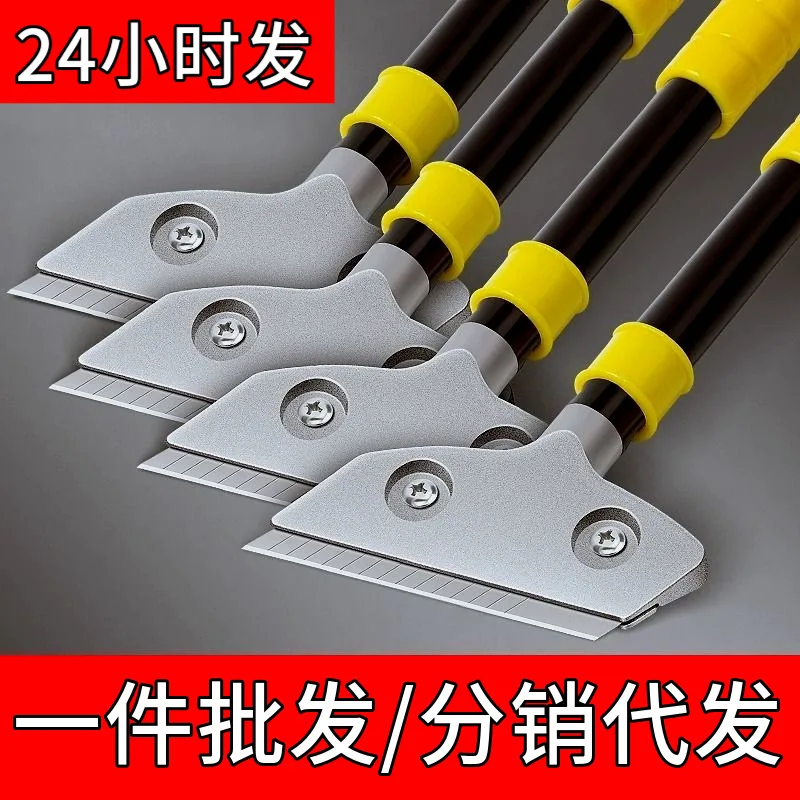
A long-handled scraper moves the work from your fingertips to your shoulders. Instead of pushing a short blade with the palm of your hand, you stand upright and drive the blade with both arms, which is the difference between clearing a floor in an afternoon and giving up on it in an hour. Handle length and blade width are the two numbers that decide how a scraper behaves, and they trade against each other: a wide blade clears more per pass but needs more force, and a long handle supplies that force while taking the load off your back.
What handle length changes
- Force available. A longer handle gives more leverage, so a wider blade can be driven with the same effort. That is what makes a 60 cm scraper the tool for large flat areas.
- Working posture. A 30 cm handle lets you work standing but close to the surface. A 60 cm handle keeps your back straight for long sessions on a floor or a wall.
- Control. Shorter handles give finer control at the edges of a job, where the blade has to stop exactly on a line.
- Access. Long handles will not fit under a workbench, behind a radiator or inside a cabinet. The short scraper gets into the places the long one cannot reach.
- Blade angle. Long handles encourage a shallow scraping angle, which lifts material cleanly. Short handles tend to be used at a steeper angle, which digs in and gouges.
- Fatigue over a shift. Handle length decides how much of a full day you can actually work, not just how fast one pass goes.
Handle length against the job
| Handle | Best at | Blade it will drive | Limit |
|---|---|---|---|
| Short handle | Edges, corners, cabinets, close work | Narrow blades | Slow across large areas; loads the wrist |
| 30 cm | Walls, benchtops, small floors, stairs | Medium and wide blades | Needs a stoop on low work |
| 60 cm | Floors, large wall panels, decking | Wide blades | Will not fit in confined spaces |
| Spare blades and extras | Keeping the tool working | Same as the handle | Only useful in the right pattern |
The pattern matters as much as the length. A blade that is supplied as part of a set has to fit the handle in the same set, so the spare blade order and the handle order have to be matched rather than guessed from the photograph.
The scrapers in this guide
Every option in this range
Sixteen configurations across three handle lengths and two blade patterns. Prices are per unit, and the extra numbers in the option names refer to the number of spare blades supplied with the handle.
| Option | Handle | Supplied with | Best for | Price |
|---|---|---|---|---|
| Short scraper | Compact handle | Single blade | Detail work and tight access | $8.99 |
| Short scraper, spare | Compact handle | Extra blades | Repeat work in confined spaces | $17.98 |
| Heavy duty short scraper | Reinforced handle | Single blade | Hard material on small areas | $26.97 |
| 30 cm scraper | 30 cm | Single blade | Walls and benchtops | $26.97 |
| 30 cm scraper, plus spares | 30 cm | Extra blades | Long runs of wall work | $26.97 |
| 30 cm scraper, two spares | 30 cm | Two extra blades | Contract work on walls | $26.97 |
| 30 cm wide scraper | 30 cm | Wide blade | Fast coverage on flat walls | $26.97 |
| 30 cm heavy scraper | 30 cm | Heavy blade | Stubborn coatings | $26.97 |
| 60 cm scraper | 60 cm | Single blade | Floors and decking | $26.97 |
| 60 cm scraper, plus spares | 60 cm | Extra blades | Large floor areas | $26.97 |
| 60 cm wide scraper | 60 cm | Wide blade | Fastest coverage per pass | $26.97 |
| 60 cm heavy scraper | 60 cm | Heavy blade | Thick material on floors | $26.97 |
| Blade, single | Fits both handles | One blade | A replacement for a worn edge | $26.97 |
| Wide blade | Fits both handles | One wide blade | Coverage on large flat areas | $26.97 |
| Long blade | 60 cm handle | One long blade | Reaching across a floor | $26.97 |
| Entry scraper | Compact | Single blade | A low-cost start on light work | $8.99 |
Because most of the range sits at one price, the choice is about the pattern and the number of blades rather than the budget. Where a handle is used daily, the options that arrive with spare blades are the ones worth taking.
Getting the blade angle right
- Keep the blade almost flat. Around 15 to 25 degrees off the surface is where a scraper lifts material rather than digging under it. A steeper angle turns the tool into a chisel and takes the surface with it.
- Push with the body, not the arms alone. On a 60 cm handle, step into the stroke and let your weight travel through the handle. Arms-only strokes are what makes a long session exhausting.
- Work in one direction on the first pass. A consistent direction lifts the material evenly and shows up where the blade is dulling.
- Overlap each pass by about a third. Overlapping keeps the cut even and stops ridges forming between strokes.
- Change the blade when it starts to slide. A blade that skates over the surface and leaves a smear has lost its edge, and pressing harder only polishes the area.
- Keep the handle in line with the blade. Twisting the handle puts a side load on the blade mount, which is what cracks the holder.
Blades, spares and wear
The blade is the part that wears, and it wears unevenly. A wide blade used on a hard coating dulls first in the middle, where the pressure concentrates, and once the middle is dull the tool starts skating across the whole surface. Keeping a spare blade in the box means the job carries on instead of stopping while a replacement is ordered.
Replacement blades have to match the handle they are fitted to. A blade that is close in size but not the same pattern will not seat properly, and a blade that does not seat squarely scrapes at an angle, which takes the surface down unevenly and forces the holder. Where a handle is bought as a set with spare blades, note the pattern before ordering more.
Blade life depends far more on technique than on material. A blade used at a shallow angle in long, steady strokes lasts many times longer than the same blade used at a steep angle in short, heavy pushes. That is the practical reason to spend a moment setting your stance before starting work rather than leaning in from the first stroke.
Keeping a scraper working
- Clean the blade and the mount after every job. Dried adhesive and grit in the holder make the blade sit proud and scrape unevenly.
- Do not lever with the handle. A scraper handle is a pushing tool, not a pry bar, and the joint is the first thing to fail.
- Store it hanging or on a hook. A scraper left on the floor is a scraper that gets stepped on, and a bent holder never sits flat again.
- Check the fixing before each session. A blade that has worked loose during the last job will not show up until it spins on the first hard pass.
Frequently Asked Questions
What handle length scraper should I buy?
Thirty centimetres for walls, benches and small floors, sixty centimetres for large floor areas. A short scraper is still needed for edges and confined spaces.
Can I use a long-handled scraper on tile?
Yes, with a blade suited to the coating. Keep the angle shallow so the blade lifts the material instead of chipping the tile.
How often do scraper blades need changing?
When the blade skates instead of cutting. On soft coatings a blade can last a full room, and on hard adhesive the same blade may be finished in an hour.
Do spare blades fit any handle?
Only the pattern they were made for. Match the blade to the handle it will be fitted to rather than buying on size alone.
Is a wide blade always faster?
On large flat areas, yes. On uneven or narrow work a wide blade catches and digs, and a narrow blade clears the same area with less damage.
Buying the right one
Match the handle to the size of the surface and the blade to the material, then keep one spare blade on hand for the pattern you use most. The scrapers in this range cover compact, 30 cm and 60 cm handles with one or more spare blades.