Blog
Tool Boxes and Bags: How to Choose Storage That Survives the Job


A tool box is the one purchase that changes how a job feels. Tools that are easy to find get used; tools loose in a van get lost, rusted and replaced. This guide covers the four storage families we stock, how to size a case properly, what the different plastics actually do, and what “waterproof” means when it is printed on a tool box.
What tool storage actually has to do
Four jobs, in order of how often they get forgotten:
- Keep tools together by task. A box for the electrical kit, a box for the socket set, a box for the drill bits. Grouping by task saves more time than any other decision.
- Protect against impact. Tools live in vans, on tailgates and in the back of trucks. Impact-resistant plastic and rounded, moulded corners matter more than wall thickness.
- Protect against water and dust. Steel tools in a damp garage rust from the inside out. A sealed lid and a gasket are the difference between a five-year tool and a two-year tool.
- Fit where it has to live. Measure the shelf, the van drawer, the under-bench gap, and the boot of the car before ordering. Storage that does not fit becomes clutter.
The four storage families we supply
Open tool boxes with an inner tray
The classic hinged box with a lift-out tray is still the best all-rounder, because you can drop tools in without thinking about it. Our impact-resistant plastic tool box with inner tray is available in several sizes up to a large workshop box, so a bench kit and a van kit can come from the same family and stack together. Choose this family when access speed matters more than sealing.
Parts boxes and organiser cases
Fixings, drill bits, crimps and small spares need compartments, not volume. The compact MJ-2072 parts box with latching lid is the pocket-sized option, while the 2072, 2073 and 2077 screw and battery organiser and the bullet-case style box in the same three sizes cover bench and vehicle use. Buying the same series in different sizes is deliberate: the small case nests inside the large one.
Sealed, moisture-resistant and waterproof cases
When the contents are worth more than the case, buy a sealed case. The 38 x 19 x 24 cm moisture-resistant tool case is the everyday answer for damp workshops, and it steps up through the MEIJIA MJ-2073 waterproof protective case and the GDT GD-1913 waterproof safety case for instruments, cameras, meters and anything that must arrive dry. The same construction logic appears in the GDT GD8073 large PP box and the GD26S compact box with lock.
Canvas and hardware bags
Bags carry more per kilo than boxes and fold flat when empty. They are the right choice for hand tools, cable, meter leads and the loose collection that accumulates around an electrician or a fitter. The canvas tool bag in 12 in to 20 in with a shoulder strap covers most kit, and the heavy-duty large tool bag takes the heavy end of the range. Bags do not seal, so anything that rusts should still go in a case inside the bag.
| Need | Family | Example |
|---|---|---|
| Grab tools fast at the bench | Open box with tray | Impact-resistant box with inner tray |
| Sort small fixings | Parts box | 2072/2073/2077 organiser |
| Keep damp out | Sealed case | Sealed tool case 38 x 19 x 24 cm |
| Protect instruments outdoors | Waterproof case | GDT GD-1913 safety case |
| Carry a lot, store flat | Canvas bag | Canvas tool bag 12-20 in |
| Kit out a service van | Mixed | GD26 outdoor box plus bag |
Sizing: dimensions beat litres
Litres are a marketing number; internal dimensions are a working number. Measure the longest tool you own, add the thickness of the tray if there is one, and check that the internal length is longer than that. Two further checks catch most mistakes: does the box fit the shelf or drawer it is going into, and can you lift it when it is full. A large box filled with steel is heavier than most people expect, and the heavy-duty bag with a shoulder strap is often the more honest answer for a heavy kit.
Materials: what the plastic codes mean
| Material | Behaviour | Where it suits |
|---|---|---|
| Impact-resistant PP copolymer | Flexes and recovers, resists cracking when dropped cold | General workshop and van boxes |
| ABS | Stiffer, holds shape well, harder surface | Small cases, instrument cases |
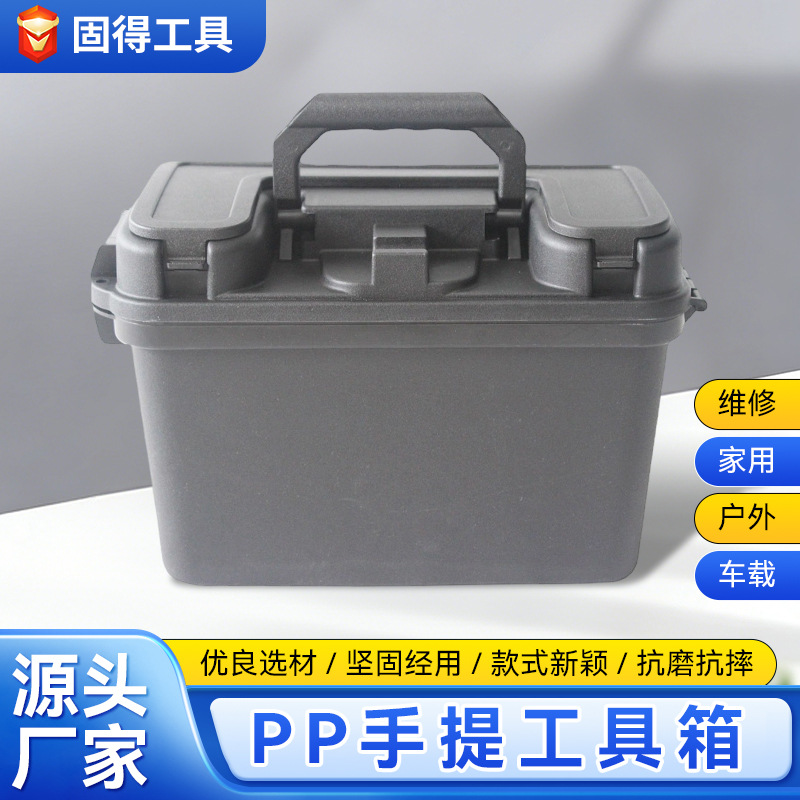
| Moulded polypropylene (hollow wall) | Light for its size, moderate impact resistance | Bullet-case style boxes, vehicle storage |
| Canvas with reinforced base | Very high strength to weight, does not seal | Hand tools, cable, meter leads |
What “waterproof” and “moisture-resistant” mean on a tool box
A moisture-resistant case keeps splashes, damp air and rain out short term, and is normally a lid with an overlap and no gasket. A waterproof protective case has a compressible gasket, a latch that pulls the lid down evenly, and often a pressure-equalising valve; it will keep water out even if the case is briefly submerged. If your kit lives in a boat, a pickup bed, or a site container, pay for the gasket. If it lives on a dry bench, moisture-resistant is enough.
Stacking, carrying and vehicle use
Flat-topped boxes stack and stay stacked; rounded “bullet” cases slide off each other unless the manufacturer moulded a stacking pattern into the lid. In a van, the useful combination is a wide flat box as the base layer, organiser cases above it, and a bag for the loose items, so that nothing has to be emptied out to reach what you need. Latch type matters here too: a single central latch speeds up access, two side latches hold a large lid flatter and keep the seal working longer.
Frequently asked questions
Is a plastic tool box as strong as a metal one?
For normal workshop and van use, a good impact-resistant plastic box outperforms thin painted steel because it flexes instead of denting, and it never rusts. Steel still wins where the box itself is exposed to a hot surface or heavy loads placed on top.
What size tool box do I need?
Measure your longest tool and your storage gap first. A box about 45 to 55 cm long covers most hand tool kits; anything larger only makes sense if you have a fixed place to keep it and do not need to carry it far.
Can I leave tools in a plastic box in an unheated garage?
Yes, but add a moisture absorber and avoid sealed boxes with damp tools inside. Condensation, not rain, is what rusts tools in an unheated workshop.
Organiser case or open box?
Organiser for anything smaller than a screwdriver, open box for anything you use continuously. Most people need one of each.
How do I stop tools rattling and chipping?
Use the tray and dividers the box came with, and pack the gaps with a cloth or foam. Movement inside the box damages finishes and dulls edges faster than the box itself wears out.
Where to start
Browse the full tool boxes and bags range, or the wider Hand Tools category if you are kitting out a workshop from scratch. Tell us what the box has to hold and where it has to live, and we will match a case to both.