Blog
Screwdriver Sets Guide: Precision Kits, Slotted and Phillips Drivers


A screwdriver set is the tool people buy twice: once cheaply, then again once the tips have rounded off. The difference between a set that survives a year and one that survives a decade is almost entirely in the steel and the fit of the tip, and both are visible in the specification if you know what to read. This guide covers the screwdriver sets we stock, from 24-in-1 precision kits to full-size slotted and Phillips drivers, and how to choose between them.
What makes a screwdriver set worth buying
- Tip material. Chrome vanadium (Cr-V) is the standard for general drivers. S2 steel is harder and holds its edge longer, which is why precision sets use it for the small bits that round off first.
- Tip fit. A tip that is slightly undersized will cam out and damage the screw head. Good sets are dimensioned, not just shaped.
- Magnetisation. A magnetic tip holds the screw while you start it, which matters most in the smallest sizes.
- Handle geometry. Precision work needs a small, rotating handle held between finger and thumb. General work needs a handle you can put your palm behind.
- Bit retention. In interchangeable sets, the holder is the weak point. A loose holder turns a good 24-in-1 kit into a bad one.
Precision sets: 24-in-1 and beyond
Precision screwdrivers are for phones, laptops, watches, glasses, controllers and small appliances, where the screws are tiny and the heads are deliberately awkward. The specification that matters is the bit steel and the number of bit types, not the piece count alone.
- 24-in-1 precision set, aluminium handle, for phones and watches
- 24-in-1 precision set with S2 steel bits
- 24-in-1 precision set, plastic or alloy handle, small or large
- 25-in-1 precision set, plastic or aluminium handle
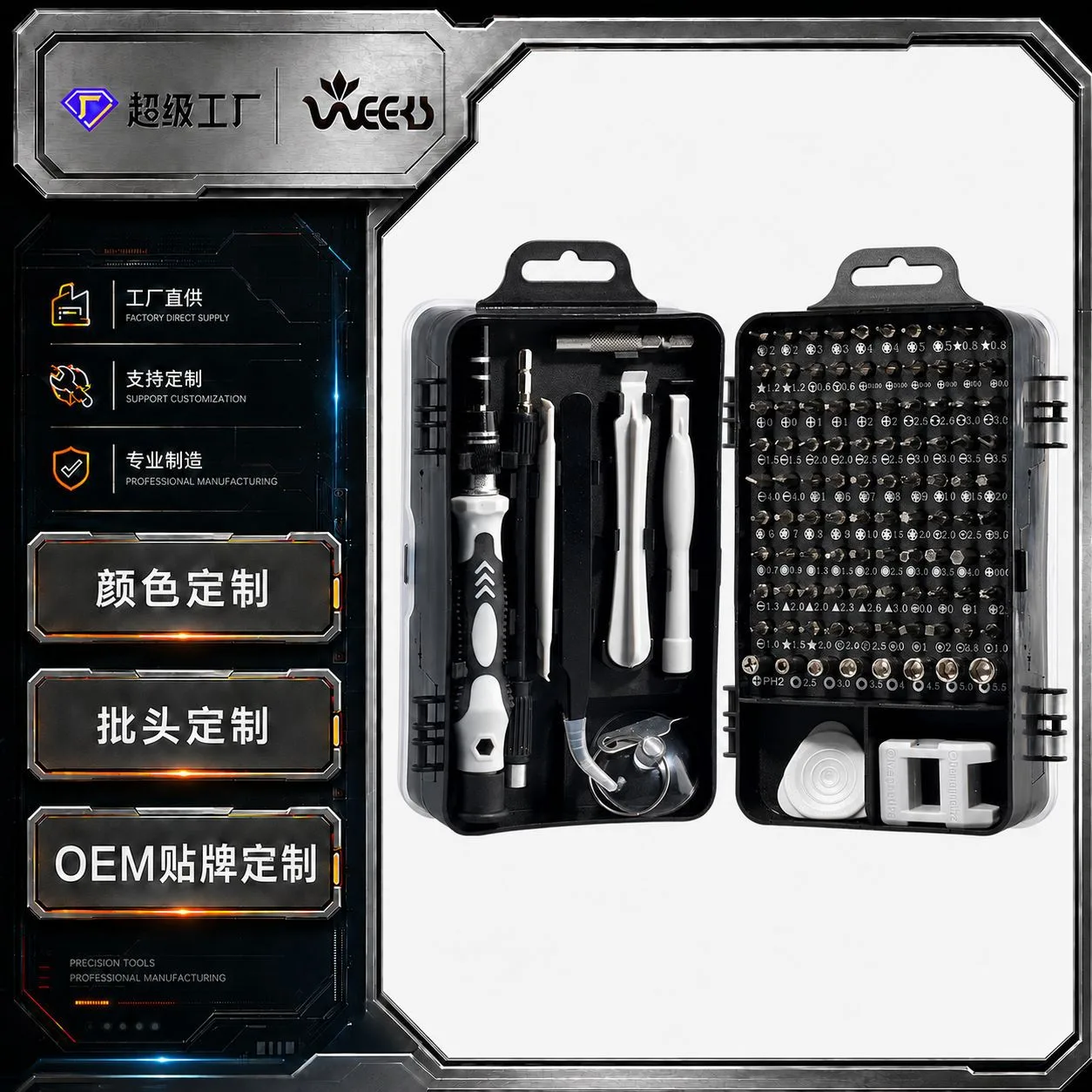
- 115-in-1 precision set, chrome vanadium, magnetic bits
- 180-in-1 S2 precision set, multi-function
The jump from 24-in-1 to 115-in-1 and 180-in-1 is not about more of the same bits; it is about covering security heads, pentalobe, triangle and square drives, and adding the pry tools and tweezers that small repairs need. If you repair phones and laptops regularly, the larger kit pays for itself the first time a pentalobe screw appears.
Full-size drivers for general work
For woodwork, electrical work and general assembly, you want fixed drivers rather than bits. A fixed driver has no holder to wear out, transmits torque directly, and can be struck at the end if the handle allows.
- Slotted 6 x 300 mm driver, chrome vanadium, magnetic tip – the long reach driver for deep terminal blocks and recessed screws
- Magnetic Phillips and slotted driver, chrome vanadium – the everyday pair
- S2 steel screwdriver, high hardness, nickel-plated – the wear-resistant option for repeated use
- Two-way driver, Phillips No. 2 and slotted 6 mm – one tool for a pocket or a meter bag
Cr-V, S2 and what the steel names mean
| Steel | Behaviour | Where it belongs |
|---|---|---|
| Chrome vanadium (Cr-V) | Tough, resists shock, moderate wear resistance | General drivers and larger bits |
| S2 tool steel | Harder, holds a sharp tip longer, less tolerant of shock | Precision bits and small drivers |
| Carbon steel with plating | Cheap, needs plating for corrosion resistance | Occasional-use and budget sets |
The practical rule: S2 where the tip is small and precision matters, Cr-V where the driver takes torque and the occasional tap.
Choosing between a set and individual drivers
| If you mainly do this | Buy this | Why |
|---|---|---|
| Electronics, phones, watches | 24-in-1 S2 precision set | S2 bits survive tiny heads; holder is the weak point to check |
| Mixed small repairs | 115-in-1 precision set | Covers security and pentalobe heads |
| Electrical and general trade | Long slotted driver plus a magnetic Phillips | Reach and torque matter more than bit count |
| One tool in a bag | Two-way driver | Two heads, one handle, nothing to lose |
| Heavy repeat use | S2 driver | Holds its tip under daily load |
Looking after a set so it lasts
Screwdrivers fail in one of two ways: the tip rounds off, or the handle cracks. Both are avoidable.
- Use the largest tip that fits the screw. An undersized tip concentrates force on a thin edge and is the fastest way to round a driver.
- Never use a screwdriver as a chisel, a pry bar or a punch. The tip is heat-treated for torsion, not for impact.
- Keep drivers out of damp tool bags, or accept that the plating will fail first.
- In interchangeable sets, keep the holder clean and check for play. A holder that wobbles damages both the bit and the screw.
Frequently asked questions
Is S2 steel better than chrome vanadium?
S2 is harder and holds a sharper tip for longer, which is why it is used for precision bits. Cr-V is tougher and more forgiving under impact and high torque. The right choice depends on whether the driver is small and precise or large and load-bearing.
How many pieces do I need in a precision set?
About 24 pieces covers phones, watches and most small appliances. Go to 115 or 180 pieces if you need security, pentalobe and triangle heads, or if you want the pry tools and tweezers that come with the larger kits.
Why do my screwdriver tips keep rounding off?
Usually because the tip is too small for the screw, or because the driver is being used as a lever. Match the tip size, keep the driver square to the screw, and stop before the head strips.
Are magnetic tips a problem near electronics?
For ordinary repairs, a magnetic tip is a help rather than a hazard: it holds the screw so you do not drop it into the case. Avoid strong magnets near magnetic storage media and spinning drives, which is a different scale of magnet entirely.
Fixed driver or bit-based set?
Fixed drivers for torque and long reach; bit-based sets for variety. Most toolkits end up with both, and the set is the one that gets lost.
Where to start
Browse the full screwdriver sets range, or the wider Tool Sets category for tap and die sets, mechanics kits and complete workshop trolleys. Tell us what you take apart most often and we will match the tip sizes and steel to it.