Blog
Canvas Tool Bags: Sizes, Shoulder Straps and Parts Box Options

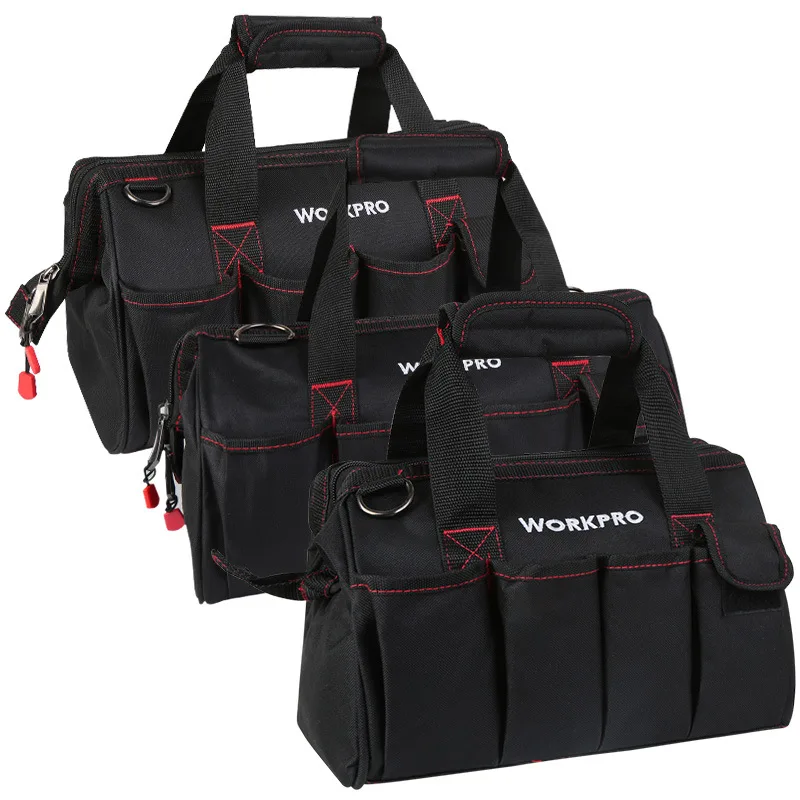
A bag carries more than a box of the same footprint because the fabric flexes around the load. That is its main advantage, and also its main drawback: a bag will accept one more tool than it should, and the person carrying it finds out at the far end of a site.
This range covers canvas tool bags from 12 in to 20 in with a zip top and a shoulder strap, supplied either on their own or with a 100-piece parts box, from 14.80 to 38.93 dollars. This guide sets out what each size carries and how to choose between them.
What the size means in a bag
Bag sizes are given in inches, and the number describes the internal length. Because fabric gives, a 16 in bag will take a 16 in saw laid flat with the handle over the end, which a rigid box of the same length will not do.
| Size | What it carries | Who it suits |
|---|---|---|
| 12 in | A small kit: driver, pliers, tape, small spanners | Maintenance and call-out work |
| 14 in | A light trade kit | One trade, one bag |
| 16 in | A full hand tool kit with a short saw | Most site work |
| 18 in | A full kit plus a drill | Installation work |
| 20 in | A large kit with bulky items | Moulded base version, heavier loads |
The step that changes how a bag is used is the one from 14 in to 16 in. Below 16 in the bag is a carry-everything kit for a specific job; at 16 in and above it becomes the bag for a whole day of work, which is why most trades settle at 16 or 18 in.
Zip top, strap and base
Three details decide whether a bag is comfortable over a working day: how the top closes, how the load is carried, and whether the base is rigid. Each one matters in a different situation.
| Feature | What it does | When it matters |
|---|---|---|
| Zip top | Keeps tools in when the bag tips | Always; an open bag spills |
| Shoulder strap | Takes the load off one hand | When both hands are needed |
| Moulded base | Stops the bag sagging when wet | On site and in wet weather |
| Folding steel tube frame | Holds the mouth open | Working out of the bag all day |
| Inner pockets | Keeps small tools upright | Screwdrivers and cutters |
The moulded base is the feature people appreciate later rather than sooner. A fabric base absorbs water from wet ground and eventually wears through where the heaviest tools sit, while a moulded base keeps the bag off the ground and keeps the load square.
Canvas tool bags in this range
Every option in this range
Canvas tool bags with a zip top and shoulder strap, from 12 in to 20 in, with several models supplied together with a 100-piece parts box.
| Option | Detail | Price |
|---|---|---|
| 14 in bag | Bag only | $14.80 |
| 12 in bag | New version, with 100-piece parts box | $24.13 |
| 14 in bag | New version, with 100-piece parts box | $25.67 |
| 16 in bag | Waterproof moulded base, with 100-piece box | $29.87 |
| 18 in bag | New version, with 100-piece parts box | $29.87 |
| 16 in bag | Folding steel-tube bag, with 100-piece box | $35.94 |
| 20 in bag | Waterproof moulded base, with 100-piece box | $38.93 |
The parts box is what separates the two groups. Buying the bag on its own is the cheaper route if fixings already live in a case of their own; buying the bundle saves about the price of the box and keeps small parts with the tools that need them.
Getting years out of a tool bag
- Lift the bag by the handles and the strap together when it is heavy, rather than swinging it by one.
- Put the heaviest tool in the middle of the base, not at one end, so the bag hangs level.
- Keep sharp saw teeth and blades away from the fabric walls; a nick becomes a tear.
- Empty the bag at the end of the week so damp tools do not sit against the canvas.
- Close the zip before lifting, since an open bag spills a whole kit when it is picked up.
- Store the bag hanging rather than on the floor, so the base stays dry and keeps its shape.
When a bag beats a box
Bags and boxes solve different problems, and the choice usually comes down to how the kit is moved rather than what is in it. A bag flexes and swallows awkward shapes; a box keeps its shape and protects what is inside it.
| Job | Bag | Box |
|---|---|---|
| Carrying on public transport | Quieter and easier to hold | Hard edges and rattling contents |
| Ladders and roof work | Can be hooked or slung | Needs a free hand |
| Power tools | Less protection | Better, especially with a case |
| Mixed kit with awkward shapes | Accepts anything | Only what fits the moulding |
| Long term storage in a van | Fabric wears on a rough floor | Lasts longer |
The pattern is that a bag is chosen by people who move a kit between jobs all day and a box by people who keep a kit in one place. That is why many trades carry both: a bag for the tools of the day and a box in the van for everything else.
Frequently Asked Questions
Is canvas better than nylon for a tool bag?
Canvas is heavier and more abrasion resistant, and it holds its shape. Nylon is lighter and dries faster. For site work canvas lasts longer; for occasional use the difference is small.
What is the shoulder strap for?
It moves the load onto the shoulder, which frees a hand for a ladder or a door. On a full 18 in bag it makes the difference between carrying the kit and leaving it in the van.
Is the 100-piece parts box removable?
Yes, and in the models that include it the box sits inside the bag. It can be taken out and used on its own when the bag stays in one place.
Will an 18 in bag take a cordless drill?
Usually, with the battery fitted and the charger left behind. A full kit with a charger tends to need the 20 in bag.
How do I clean a canvas bag?
Brush out dust, wipe with a damp cloth and let it dry open. Do not machine wash it, as that damages the coating and the stitching.
Choosing the size and the bundle
Decide whether small parts travel with the tools, then pick the size that takes the longest tool laid flat. The canvas tool bag range here covers both the bag-only and bundled versions.
Where the choice is between a larger bag and a smaller bag plus a parts box, the second option is usually the better one. It keeps the weight lower on the shoulder and gives fixings a home of their own instead of the bottom of the bag.