Blog
Heavy Duty Tool Bags: Compartments, Cup Holders and Sizes


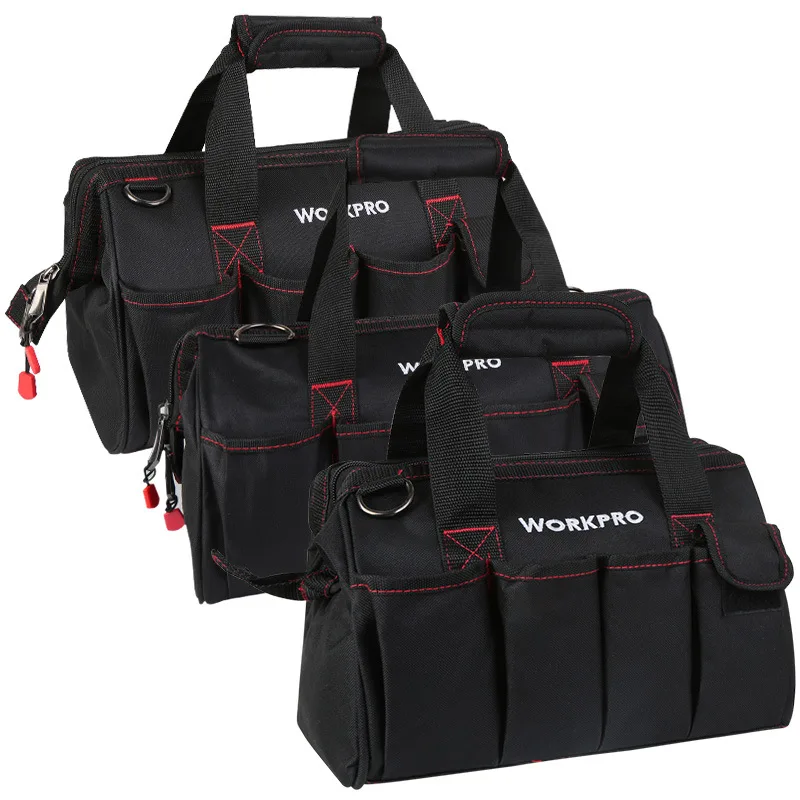
A tool bag on site does two jobs: it carries a kit to the work, and it acts as a place to work from. The second job is what separates a heavy duty bag from a general one, because a bag that stands open on the ground has to hold its shape while tools are taken out and put back all day.
This range covers heavy duty bags in 35, 40 and 45 cm sizes, in standard and compartment versions, with cup holder models at the larger sizes, from 29.99 to 45.99 dollars. This guide explains what each size carries and which features are worth paying for.
What the size changes
The three sizes are close enough that the difference shows up in use rather than on paper. The smallest bag takes a kit and nothing more; the largest takes a kit plus the bulky extras that otherwise travel loose in a van.
| Size | Dimensions | What it takes |
|---|---|---|
| Small | 35 x 30 x 12 cm | A full hand tool kit and a small saw |
| Medium | 40 x 35 x 12 cm | The above plus a drill or a level |
| Large | 45 x 36 x 15 cm | A large kit with bulky items and PPE |
Depth is what people underestimate. All three bags are around 12 cm deep at the small and medium sizes and 15 cm at the large, and that measurement decides whether a drill with a battery stands upright or has to lie across the other tools.
Standard, compartment and cup holder
The versions differ in how the inside is arranged, and the arrangement decides how quickly a tool can be found. Compartments suit tools that are used one at a time; an open bag suits a kit that is tipped out onto a mat.
| Version | Internal layout | Best for |
|---|---|---|
| Standard | One main space with side pockets | A mixed kit carried and emptied |
| Compartment | Divided bays that hold tools upright | Working out of the bag all day |
| Cup holder | External pockets for bottles and cans | Site work with a drink within reach |
| Cup holder, compartment | Both of the above | Long days on site |
The compartment version is the one that changes habits. When every tool has a bay, the bag can be opened on the ground and worked from directly, which saves the step of laying tools out and gathering them again at the end of the job.
Heavy duty tool bags in this range
Every option in this range
Heavy duty tool bags in three sizes, in standard and compartment layouts, with cup holder versions at the medium and large sizes. Prices are per bag.
| Option | Detail | Price |
|---|---|---|
| Small, standard | 35 x 30 x 12 cm | $29.99 |
| Small, compartment | 35 x 30 x 12 cm | $36.99 |
| Medium, standard, cup holder | 40 x 35 x 12 cm | $39.99 |
| Medium, compartment, cup holder | 40 x 35 x 12 cm | $42.99 |
| Large, standard, cup holder | 45 x 36 x 15 cm | $42.99 |
| Large, compartment, cup holder | 45 x 36 x 15 cm | $45.99 |
The compartment layout adds about seven dollars at the small size and three dollars at the largest, while the step from small to medium standard costs three dollars and brings more capacity and the cup holder pockets with it.
Loading a heavy bag
- Spread the weight along the base instead of stacking it in the middle, so the handles stay level.
- Keep tools that are used together in the same bay, not grouped by type.
- Do not overfill above the rim; the zip takes the strain every time the bag is closed.
- Put sharp items in side pockets rather than against the main fabric wall.
- Check the base stitching and the handle rivets each season, before they fail on site.
- Empty the bag weekly so dust and swarf do not accumulate in the seams.
What a compartment bag changes about a working day
The difference between a bag that is emptied and a bag that is worked from is small at the start of a day and large at the end of it. Opening the bag on the ground and taking tools straight out removes the two habits that cost the most time: laying the kit out and packing it up again.
| Habit | Standard bag | Compartment bag |
|---|---|---|
| Finding a tool | Look through the load | Reach into its bay |
| Packing up | Gather tools and repack | Return each tool to its bay |
| Spotting a missing tool | Difficult | An empty bay shows at once |
| Working in the rain | Bag must be closed between tools | Bays keep rain off the kit |
The empty bay is the small advantage that turns out to matter most, because a tool left at the last job is easy to notice when the place it belongs to is visible. With a standard bag, a missing screwdriver is only found when it is needed.
That said, compartments do not suit everything. A hammer, a drill or a tape measure will not sit in a narrow bay, and a bag bought entirely for bays ends up with the larger tools loose on top of them. The strongest arrangement is a compartment bag with one open section, which is why the larger sizes in this range tend to be the ones that get used on long jobs.
Frequently Asked Questions
How heavy can a bag like this carry?
A heavy duty bag will carry a full hand tool kit plus a drill, but the limit is the person, not the bag. Loads much above twenty kilograms become a two-hand carry whatever the handles.
Are the compartments removable?
No. If the bag may be used for mixed loads, the standard version is the more flexible choice, since an empty bay wastes space.
What is the cup holder for?
A bottle or a can, kept upright and away from the tools. On site it stops a drink being put down in the dust or knocked over on a bench.
Can the bag be carried on a shoulder?
The handles are designed for a hand carry. A shoulder strap is better on a tool bag built around one, since a fully loaded bag on one shoulder gets tiring.
Will the large bag fit in a van shelf?
At 45 cm long it usually does. Check the shelf height, because a full bag is around 36 cm tall at the large size.
Choosing the right bag
Work out whether the bag will be emptied at each job or worked from directly, then choose the layout. The heavy duty tool bag range here covers both layouts across three sizes.
If the kit is still growing, buy the medium standard version now and add a compartment bag later for the tools of one trade. Buying the largest bag first tends to produce a bag that is too heavy to carry and gets left in the van.