Blog
Practice Butterfly Knives: Why Blunt Trainers Matter

A practice butterfly knife is a handling tool, not a cutting tool. It is made without a sharpened edge and usually with a blunted tip, so that the movements involved in opening and closing it can be learned without the risk that comes with a live blade. For collectors and for anyone interested in the mechanism, the trainer is the sensible starting point.
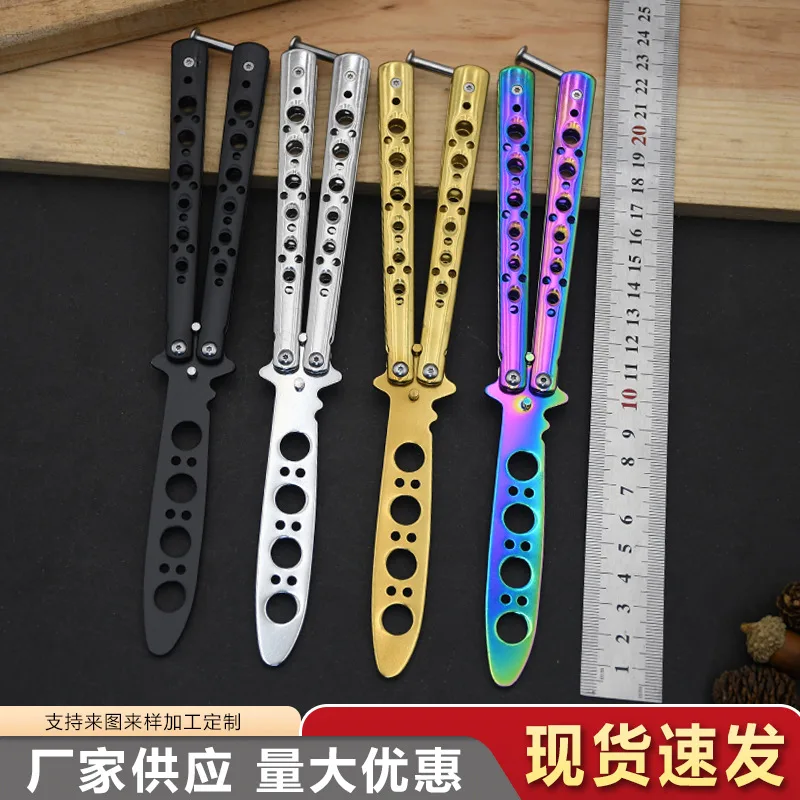
This range covers a stainless steel unsharpened trainer in four finishes. This guide covers what a trainer is for, what to check on the build, and the legal question that should be answered before ordering.
What makes it a trainer
Three features separate a trainer from a live blade. The edge is not ground sharp, the tip is blunted, and the blade is often drilled with holes, which lightens it and makes the balance closer to that of a live knife without the edge. The mechanism, the handles, the pivot and the latch are otherwise the same as on a functional example.
| Feature | Trainer | Live blade |
|---|---|---|
| Edge | Unsharpened, usually with a safety edge | Ground and sharpened |
| Tip | Blunted | Pointed |
| Blade | Often drilled or slotted to match the weight | Solid |
| Mechanism | Identical pivot, handles and latch | Identical |
| Purpose | Handling practice and collection | Cutting |
Because the mechanism is the same, a trainer teaches the actual handling of the design rather than an approximation of it. The weight and balance differ slightly from a live version, which is the only real limitation of practising with one.
Check the law before buying
Butterfly knives are restricted or prohibited in a number of countries and in some regions within them, and the rules for trainers are not always the same as the rules for live blades. Some jurisdictions treat any knife with a free-swinging handle as a prohibited item regardless of the edge, while others exempt an unsharpened training version.
| Question to answer | Where to check | Why it matters |
|---|---|---|
| Is the design restricted where I live? | National and regional weapons legislation | Ownership can be an offence regardless of the edge |
| Are trainers treated differently? | The same legislation, plus customs guidance | An exemption for trainers is not universal |
| Can it be imported? | Customs rules for the destination country | Restricted items are seized at the border |
| Can it be carried outside the home? | Local rules on carrying | A lawful possession is not always a lawful carry |
| Are age limits applied? | Retailer and local rules | Some jurisdictions restrict sale to adults |
The practical advice is to check the position in your own jurisdiction before ordering, and to treat a trainer exactly as you would a live blade for storage and transport. A trainer is safer to practise with, but that is a separate question from whether it is legal to own or carry.
Practice butterfly knives in this range
Every option in this range
A stainless steel unsharpened trainer in four finishes. Prices are per item.
| Finish | Detail | Price |
|---|---|---|
| White | Unsharpened trainer, stainless steel | $8.99 |
| Black | Unsharpened trainer, stainless steel | $8.99 |
| Gold titanium finish | Unsharpened trainer, coloured finish | $11.87 |
| Colour titanium finish | Unsharpened trainer, coloured finish | $11.87 |
The two coloured finishes cost more than the plain ones, which reflects the finishing rather than any difference in the mechanism. For practising, the plain version does the job; the coloured finishes are bought mainly by collectors.
Build checks that matter
- Check the pivot for play, since a pivot with side-to-side movement will not swing predictably.
- Check that both handles swing freely without binding against each other.
- Look at the latch, which is the part that wears and the one that decides how it carries closed.
- Confirm the tip is genuinely blunted, since some trainers arrive with a point.
- Check the handle material, as a heavy metal handle changes the balance significantly.
- Look for burrs or sharp edges on the handle cut-outs, which are uncomfortable in the hand.
Practising safely
Even a blunt trainer can bruise a finger or break a nail, and the habits worth building are the ones that make handling predictable. Working over a soft surface, keeping fingers clear of the path of the handle, and stopping as soon as attention wanders are all part of learning the mechanism rather than fighting it.
It is also worth treating the trainer with the same care as a live blade in storage. Kept in a case, away from children and out of a pocket where it could be mistaken for something else, it stays a training tool and nothing more. That habit, rather than the absence of an edge, is what people who handle knives well have in common.
Frequently Asked Questions
Is a practice butterfly knife safe?
It has no cutting edge, so it cannot cut, but it can still bruise fingers and break nails. The mechanism is the same as a live version and needs the same care.
What is the difference between a trainer and a live blade?
The edge, the tip and often the weight of the blade. The pivot, handles and latch are the same, which is why a trainer teaches the real handling.
Are trainers legal where I live?
It depends on local law, and not every jurisdiction exempts trainers. Check national and regional rules, and customs rules if importing, before ordering.
Can I carry a trainer outside the house?
Possession and carrying are separate questions in most legal systems. Check the local rules before carrying one in public.
Why do trainer blades have holes?
To lighten the blade so the balance is closer to that of a live example. It also makes the trainer immediately recognisable.
Choosing the right trainer
Confirm the tip is blunt and the pivot is tight, and check the local rules first. The unsharpened stainless steel trainer in this range comes in four finishes.