Blog
Measuring Tools Guide: Tape Measures, Steel Rules and Precision Gauges


Measuring tools are the cheapest part of a toolkit and the ones that decide whether everything else fits. A tape that reads 3 mm long makes every cut 3 mm long, every frame 3 mm out, and every cabinet door that follows slightly crooked. This guide covers the measuring tools we stock, the two or three specifications that separate a tape measure that lasts a month from one that lasts five years, and how to check that the tool you already own is still telling the truth.
What the job actually asks of a measuring tool
Three requirements sit behind every measuring tool, and they pull against each other:
- Accuracy. The graduation has to match the real dimension. On a steel tape the accuracy class is set by the manufacturer and is normally expressed as a tolerance over a given length.
- Repeatability. The same measurement taken twice must give the same reading. A tape with a loose end hook or a bent blade fails here long before it fails on accuracy.
- Survivability. A tape measure lives in a pocket, on a belt, on a bench under a stack of offcuts, and on the floor of a van. Drop resistance and blade coating decide whether it still reads correctly next year.
Tape measures: the specifications that matter
Blade width and standout
Blade width is measured across the steel and is normally 16 mm, 19 mm or 25 mm. Wider blades stand out further before they collapse, which is why a 25 mm blade can be extended two and a half metres across a gap while a 16 mm blade folds at about half that. If you measure across rooms or between studs on your own, buy 25 mm. If you measure inside cabinets and around machinery, a compact 16 mm tape is easier to place.
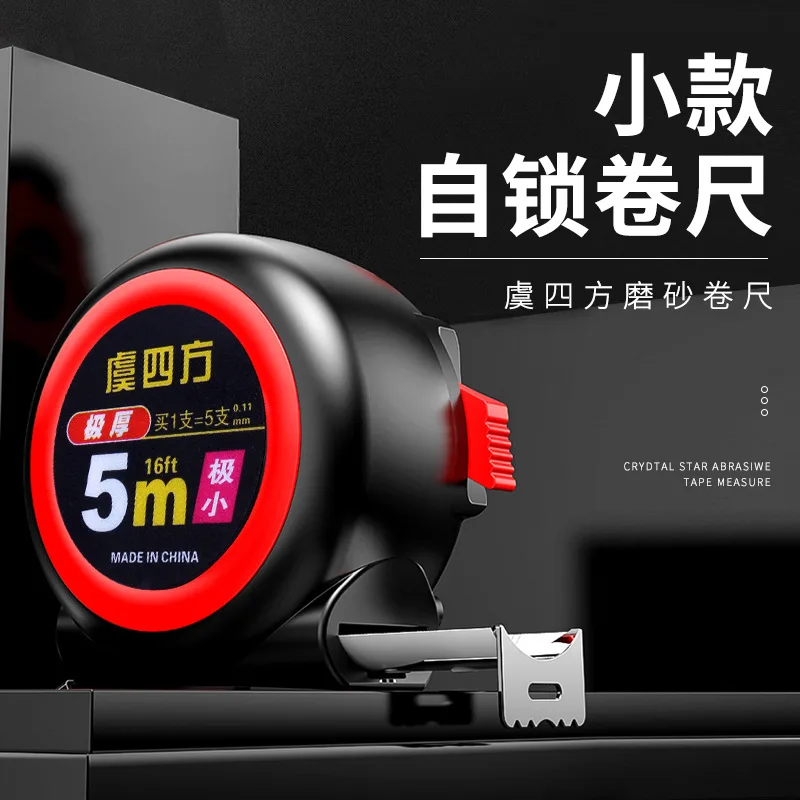
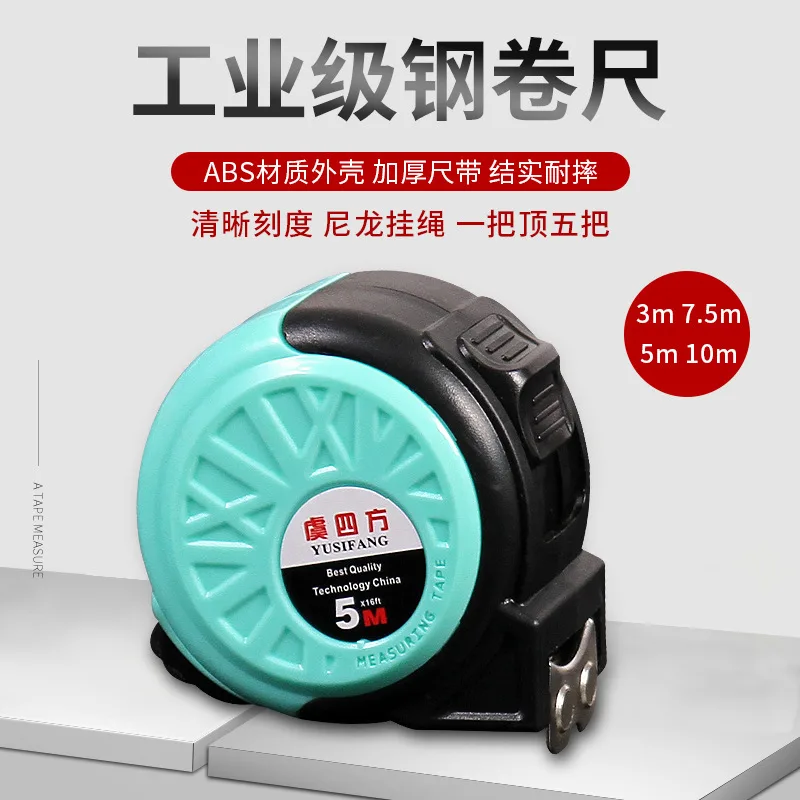
Our 16, 19 and 25 mm self-locking tape measure covers all three widths in 3 m, 5 m, 7.5 m and 10 m lengths, so you can standardise on one model across a workshop.
Locking: self-locking, auto-lock and manual
A self-locking tape holds the blade out until you press the release, which is what you want when measuring alone. A manual-lock tape only holds when you push the slider. The difference sounds trivial until you are measuring a 4 m span overhead with one hand.
The end hook, and why it moves on purpose
The hook on a steel tape is deliberately loose by the thickness of the hook, so that it reads correctly whether you are pushing it against a surface or hooking it over an edge. That is also why the hook is the first thing to go wrong: a bent hook, or one that has been pushed back flat, adds a consistent error to every measurement. A magnetic hook, as on the tape linked above, holds to steel frames and racking and removes one hand from the job.
Blade coating
A plain painted blade wears through where the tape rubs, which is exactly where you read it most. Nylon coating and frosted finishes are the two ways manufacturers slow that down: nylon resists abrasion, and a frosted, anti-glare blade is easier to read under site lighting. The nylon-coated tape with an 11-wire embossed blade and the thickened frosted-blade tape are the two upgrades worth paying for if you measure all day.
Case construction
Inside the case, the spring and the brake do the work; outside, the shell takes the abuse. Rubberised and double-layer cases survive drops that crack a plain ABS shell. Compare the rubberized-case self-locking tape, the anti-drop rubber-cased tape and the double-layer cased tape with an anti-rust blade.
| Family | Best for | What to check before buying |
|---|---|---|
| Compact self-locking 16-25 mm | Cabinet work, machine setting, tool belt | Standout is short; fine for bench work |
| Self-locking 19 and 25 mm | General site and workshop measuring | Blade coating and hook condition |
| Dual-scale metric and inch | Mixed drawings, imported machinery | Read the correct edge every time |
| Steel tape, transparent case | Retail and counter sales | Case shell thickness |
| Stainless blade, bulk packs | Trade counters, kit assembly | Sold by the box, not the piece |
Steel rules and straight edges
A steel rule is the tool you reach for when a tape measure is the wrong shape: marking out on a bench, checking a machine setting, or reading a depth against a shoulder. The rules we stock run from 10 cm to 2 m, in double-sided and single-sided graduations, in plain or thickened widths. The 10 cm to 60 cm double-sided rule set is the standard bench kit, while the 3CR13 wide-blade rule up to 100 cm gives a stiffer edge for longer marking out. If your drawings mix metric and imperial, the metric and imperial rule from 150 mm to 1 m avoids converting in your head.
Long tapes for site, landscaping and racking
Above 10 m you stop carrying a pocket tape and start using a reel or a frame tape. Closed-reel long tapes with fibreglass or linen blades tolerate damp and dirt; frame tapes with a winding handle are faster over 30 m and up. The 30 m, 50 m and 100 m frame tape with a nylon-coated blade and the 10 m to 100 m closed-reel tape cover setting out, fencing, drainage runs and warehouse floor marking. For ground marking where a tape is awkward, the hand-cranked disc tape in 20 m to 100 m rolls out and winds back in one motion.
Precision instruments for inspection work
When the tolerance is in hundredths of a millimetre, mechanical instruments take over from tapes. Two specialist gauges in our range are worth knowing about because they solve problems that calipers cannot: the blind hole bore gauge reads internal diameters, grooves and undercuts that a caliper jaw cannot reach, and the span-over-balls gauge checks involute splines and gear teeth across pins or balls against drawing limits. Both are inspection instruments rather than everyday tools, and both need a known reference to set them before use.
How to check a tape measure is still telling the truth
You can verify a tape in under a minute and you should do it whenever a tape has been dropped:
- Hook the tape onto a known straight edge, such as a steel rule, and read the same dimension at two positions.
- Push the tape hard against a surface and read the same dimension. Hooking and butting should give the same number.
- Pull the blade out 2 m and sight along it. A visible kink or a twisted blade means the graduations no longer follow the edge.
- Compare against a second tape or a steel rule. A consistent offset means the hook is bent or the blade has stretched.
Storage and care
Retract the blade slowly rather than letting it snap back, keep tapes out of standing water, and wipe grit off the blade before it is wound in, because grit inside the case wears the spring that gives the tape its standout. Steel rules rust where the coating has been scratched, so a light oil on the edge after use is worth the ten seconds it takes.
Frequently asked questions
What is the most accurate measuring tool?
For everyday work, a steel rule or a good tape measure is accurate enough for cutting and setting out. For fits and tolerances below 0.1 mm, you need a caliper, a micrometer or a dedicated gauge, used at a stable temperature and re-checked against a reference.
Why does my tape measure read differently at the tip?
Because the end hook is designed to slide by its own thickness. If hooking and butting give different readings, the hook is bent and the tape should be replaced or the hook straightened and re-checked.
Is a wider blade always better?
Only when you measure one-handed over distance. A 25 mm blade gives more standout but weighs more and takes a bulkier case; for bench work a 16 mm blade is easier to place accurately.
What is a 11-wire blade?
It refers to the number of reinforcement wires or ribs formed into the blade to stiffen it and improve standout. More wires generally means a stiffer blade and better one-handed reach.
Metric or imperial?
Match the drawings you actually work from. Dual-scale tapes are a compromise: they solve the occasional imperial dimension but they double the chance of reading the wrong edge under pressure.
Where to start
Browse the full measuring tools range, or the wider Cutting & Measuring Tools category for drill bits, saw blades and cutting accessories. Tell us the lengths you measure most and whether you work one-handed, and we will point you at the right blade width and case.